

CEO thought leadership works best when you treat it like a process, not a one-off post. If you want steady output, tighter message control, and fewer review issues, focus on five steps: pick the right topic, shape one clear point of view, review in order, publish in the right place, and track what happens after it goes live.
Here’s the short version:
- Step 1: Choose a topic where the CEO has direct experience and the audience has a clear question
- Step 2: Turn that experience into one sharp point
- Step 3: Review for facts, risk, approvals, and voice
- Step 4: Publish the full piece on the best main channel, then trim it for other channels
- Step 5: Track replies, traffic, and business response for 30 to 90 days
A few numbers show why this matters:
- 48% of company reputation can be tied to the CEO’s personal brand
- 85% of B2B marketers say LinkedIn gives them the best value among social platforms
- 75% of B2B buyers and C-suite readers say thought leadership led them to look into a product or service they were not weighing before
What I like about this framework is that it keeps the work simple. Pick one audience. Make one argument. Check every claim. Publish with intent. Learn from the response. That’s the whole system.
The article lays out those five steps in a clear order so a team can use the same workflow again next time.
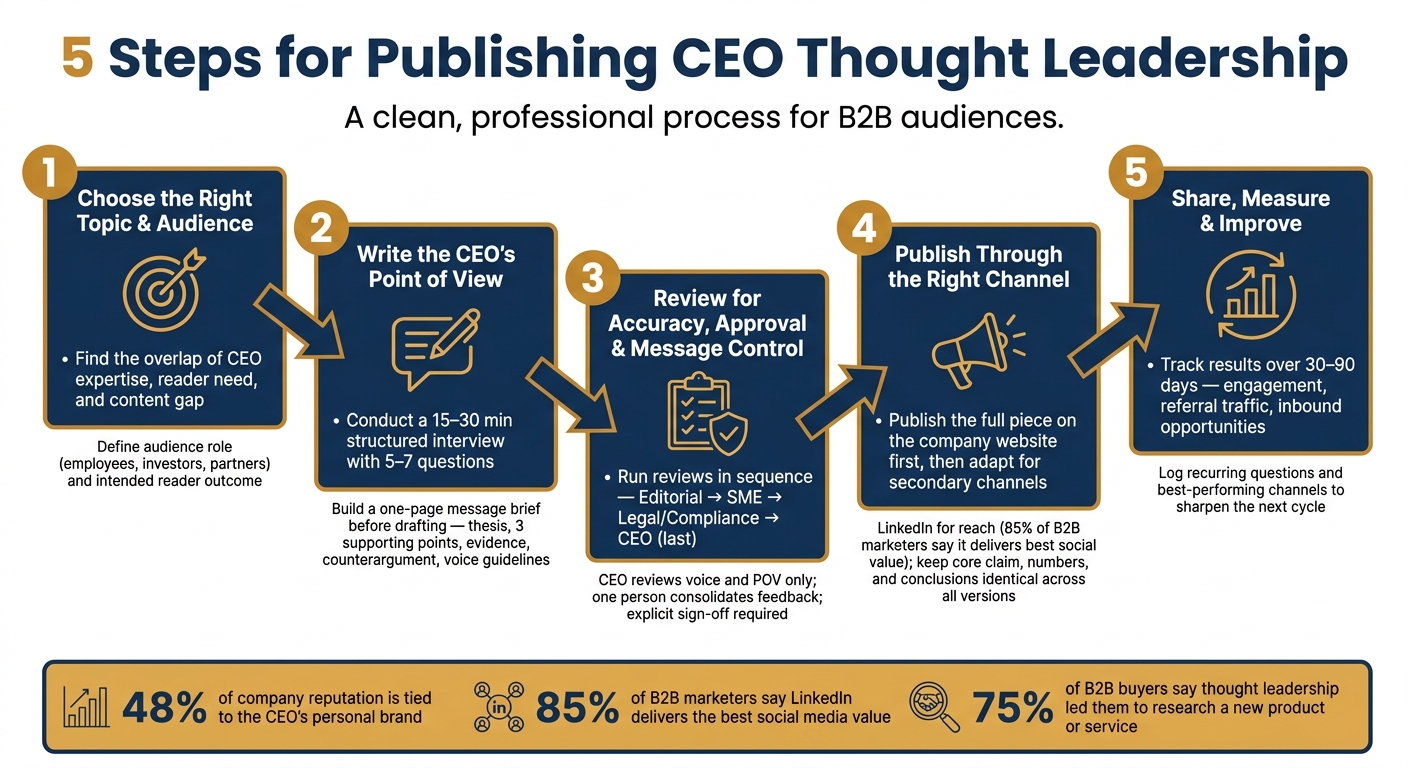
5-Step CEO Thought Leadership Publishing Framework
Step 1: Choose the Right Topic and Audience
Choose topics where CEO know-how, reader need, and a clear content gap meet. That overlap is what separates thought leadership from generic commentary.
Pick a Topic with Expertise, Relevance, and Evidence
Start with what you already have inside the business: customer questions, performance metrics, operating issues, and growth milestones. Then compare that with what’s already out there. Look at recent coverage and ask: is this topic packed with the same talking points, or is there still room to add something new?
That gap matters even more when the CEO can speak from direct experience. Readers can tell when a piece comes from lived work instead of polished talking points. Topics that let you share real lessons tend to land better. And yes, that includes the messy parts. If setbacks or missed goals help explain the lesson, include them.
"A frequent mistake that executives make… is making it sound too promotional and skipping the company’s obstacles over the year. However, you can make these obstacles a key point."
Once the topic feels solid, get specific about who it’s for.
Define the Audience and the Intended Reader Outcome
Before drafting, define the audience. Start with reader role: employees, investors, or partners. That one choice shapes the level of detail, tone, and structure.
Clear audience focus keeps the piece tight from draft to review to publishing. After that, decide what the reader should walk away with. Maybe it’s a new way to think about a problem. Maybe it’s practical advice. Maybe it’s one clear next step.
Use the worksheet below to lock those choices in.
| Worksheet Field | What to Define |
|---|---|
| Core Problem | The gap or challenge the piece addresses |
| Target Decision-Maker | The primary reader by role, industry, or company stage |
| CEO Point of View | Your angle, grounded in direct experience |
| Supporting Evidence | Data, metrics, or research that backs the point |
| Intended Outcome | A new frame, a decision tool, or a clear action |
Use this brief to keep the draft narrow and on track. With the topic and audience set, the next step is turning that brief into the CEO’s point of view.
sbb-itb-2fdc177
Step 2: Write the CEO’s Point of View
Once the topic and audience are set, the next job is simple to describe and hard to do well: turn the CEO’s knowledge into one clear, defensible point of view.
Capture Original Insight in the CEO’s Own Voice
The most dependable way to get that point of view is through a structured interview or briefing. In most cases, that means a 15- to 30-minute conversation, recorded with the CEO’s permission. Send a short pre-read first with the proposed topic, working thesis, and five to seven questions. Then use open-ended prompts: what has changed in the industry that most effective leaders are missing, what decision taught the lesson, where the CEO parts ways with the standard view, and what the reader should do differently. When an answer gets interesting, dig deeper. Ask for a specific example, decision, result, or lesson.
The goal is to catch the strongest idea and keep the CEO’s wording, priorities, and decision logic intact.
If a sharp phrase makes the argument clearer, keep it. If corporate filler starts to sneak in, cut it. A good gut check is to read a paragraph out loud and ask: would the CEO actually say this to an employee, customer, or journalist? If the answer is no, rewrite it.
A strong POV brings together three things:
- A credible observation
- A distinct interpretation
- A useful recommendation
For example, don’t settle for a line like "companies should innovate faster." That’s vague and forgettable. A CEO in a regulated industry might say: "In a regulated market, innovation improves when teams reduce the number of approval gates for small experiments rather than treating every experiment like a product launch." That works because it’s specific, tied to operating experience, and helpful to the reader.
Build a Message Brief Before Drafting
Before you write a single sentence of the article, build a one-page message brief. This keeps the draft tight and gives the CEO something concrete to review before anyone spends time on a full article. Think of the brief as the draft’s guardrail.
Use it to keep the article narrow and easy to review.
| Brief Element | What to Define |
|---|---|
| Thesis | One sentence stating the article’s central argument |
| Audience and outcome | The specific reader and the decision, belief, or action the article should influence |
| Three supporting points | The main reasons the thesis holds up |
| Evidence for each point | Company data, customer patterns, or attributed research |
| Counterargument | The strongest objection and the CEO’s response |
| Practical implication | What the reader should do next |
| Voice and boundaries | Preferred CEO language, topics to avoid, confidential information, and any required review |
| Risk check | Claims, names, figures, or forward-looking statements that need review |
During drafting, label each statement as fact, interpretation, or recommendation. That sounds a bit strict, but it saves time later.
- Facts need verification and attribution.
- Interpretation should be framed clearly as the CEO’s analysis.
- Recommendations should say who should act, what should change, and under what conditions.
That separation matters. Without it, opinions can start to read like proven conclusions. It also makes the Step 3 review much easier.
On risk controls, keep the language supportable. Replace vague superlatives like fastest or only with wording you can back up. Remove confidential customer details, nonpublic deal terms, and personal data. Be careful with forward-looking claims, and use bounded language when one is needed.
The brief is also the place to flag anything that needs legal, compliance, or investor-relations review before the article moves ahead. It sets up Step 3’s accuracy and approval review.
Step 3: Review for Accuracy, Approval, and Message Control
Once the message brief is done, move the draft through a staged review process. Trying to get approval from everyone in one pass usually creates a mess: mixed edits, slow decisions, and a watered-down CEO point of view.
Run Reviews in a Clear Sequence
Give each reviewer one clear job.
Start with editorial review. Check the draft for clarity, structure, and support. Flag names, numbers, and quotations for fact-checking – don’t fill in gaps or make assumptions.
Then bring in an SME to review technical claims, data, terminology, and source interpretation. Check every material statistic against a primary source. If you can’t support a claim, either attribute it, qualify it, or cut it. This matters even more with superlatives. Words like first, best, and only need solid proof.
Bring in legal, compliance, or communications review only when the topic calls for it. That includes regulated products or industries, financial or performance claims, pending litigation, employment matters, material business developments, security issues, customer data, proprietary technology, partnerships, competitors, or topics that could affect the company’s reputation or investor communications. Their job is to reduce risk with precise edits, not sand down the CEO’s point of view.
The CEO reviews last, when the draft is almost done. That review should focus on voice, point of view, and whether the piece can hold up in public. The CEO shouldn’t be line-editing copy. Once approved, the draft is ready for the right channel.
Use a Message-Control Checklist
Before publication, run through a final set of checks:
| Control Area | What to Verify |
|---|---|
| Central argument | Headline, intro, examples, and conclusion all support one clear CEO position |
| Factual accuracy | Names, dates, figures, calculations, links, and quotations are correct |
| Source attribution | Research, statistics, and third-party ideas are credited to their original sources |
| Evidence quality | Material claims rely on primary or reputable sources, and opinions are distinguished from facts |
| Confidentiality | No trade secrets, nonpublic financials, personal data, or undisclosed customer details appear |
| Customer references | Names, results, logos, quotations, and case details have documented permission and accurately reflect the relationship |
| Conflicts of interest | Investments, board roles, commercial relationships, sponsorships, or competitor references are disclosed or removed where relevant |
| Tone and voice | Writing sounds like the CEO, avoids unsupported superlatives, and fits a U.S. business audience |
| Legal and communications clearance | Required specialist reviews are complete, with unresolved issues documented |
| CEO sign-off | CEO approves the final version, headline, bio, graphics, and social copy |
After feedback is consolidated, lock the final version. Keep one version record that shows what changed, why it changed, and who approved it. Put one person in charge of consolidating feedback, and require explicit CEO sign-off before anything goes live.
Readers treat thought leadership as a sign of organizational competence. That means factual errors and unsupported claims can damage trust fast.
Step 4: Publish Through the Right Channel
Once the CEO’s article gets final sign-off, it’s tempting to hit publish everywhere at once. That usually backfires. When you push the same piece across every platform without a plan, the message gets scattered and results get messy to track. Start with the approved message brief, and use that as the base for every version.
Select a Primary Channel First
Use the company website or blog as the main home for the full article. You control the copy, design, calls to action, and tracking there. Google’s guidance favors content that shows first-hand expertise, serves a clear audience, and helps readers complete a specific task. A well-built company article lines up with those standards.
Pick the primary channel based on the business goal, not routine.
- Use the company site when you want a full article with proof, context, and search value.
- Use a contributed article when the goal is to reach a new industry audience.
- Use email when you’re writing for a private subscriber list.
- Use LinkedIn or Quora when the point is timely, narrow, and doesn’t need a long case to support it.
| Channel | Audience reach | Control | Content depth | Expected lifespan | Measurement options |
|---|---|---|---|---|---|
| Company website or blog | Existing visitors, search users, prospects, customers | Highest | Best for the complete article, evidence, and SEO | Long-term | Page views, engaged time, scroll depth, conversions, backlinks |
| CEO LinkedIn profile | Followers, professional network, potential for sharing | Medium | Short argument, excerpt, or link | Short | Impressions, engagement rate, link clicks, qualified conversations |
| Company social profile | Brand followers, targeted communities | Medium | Short posts, visuals, clips | Short- to medium-term | Reach, engagement, clicks, assisted traffic |
| Email newsletter | Known, opted-in subscribers | High over subscriber list | Summary, excerpt, or newsletter-native analysis | Medium; time-sensitive | Open rate, click-through rate, conversions, unsubscribe rate |
| Contributed publication | New, relevant external audience | Lower; editor controls timing, edits | Focused article tailored to the publication | Long-term | Referral traffic, backlinks, attributed opportunities |
Content Marketing Institute’s 2025 B2B research found that 85% of B2B marketers say LinkedIn delivers the best value of any social media platform. So LinkedIn is a strong place to spark interest. But the full case should still live on the company site.
Adapt the Core Message for Each Channel
Once you’ve picked the main channel, adjust the article for each secondary outlet using one simple rule: keep the main claim, numbers, and conclusions the same, but change the opening, detail level, and format to fit how people read on that platform.
A CEO LinkedIn post should lead with tension or a personal observation, land one clear insight, and invite replies. It should not dump a full 1,500-word article into a post box. An email should open with the point that matters most to that subscriber group, then link cleanly to the full piece. A contributed article should reshape the argument for that publication’s readers, strip out promotional copy, and add outside context.
The 2024 Edelman–LinkedIn B2B Thought Leadership Impact Report found that 75% of B2B buyers and C-suite executives said a piece of thought leadership led them to research a product or service they hadn’t previously considered. That kind of effect depends on having the full argument and supporting proof in one place people can trust. In most cases, that place is the company site.
Before anything goes live, assign clear owners and deadlines in a shared editorial workflow:
| Channel | Channel owner | Approver | Format | Required adaptations | Publication status |
|---|---|---|---|---|---|
| Company website | Content lead | CEO and communications lead | Full article, author bio, SEO fields | Headline, sources, accessibility, CTA, metadata | Draft / in review / approved / published |
| CEO LinkedIn profile | Executive communications lead | CEO or designated approver | Text post or article link | First-person voice, shortened, discussion prompt | Draft / approved / scheduled / live |
| Company social profile | Social media manager | Brand or communications lead | Short post, quote card, or clip | Simplified language, tracked link, visual dimensions | Draft / approved / scheduled / live |
| Email newsletter | Email marketing owner | Marketing and legal/compliance | Subject line, summary, CTA, tracked link | Audience segment, subject line, consent, accessibility | Draft / QA / approved / sent |
| Contributed article | External relations lead | CEO, legal, and publication editor | Publication-specific article or op-ed | Word count, style, exclusivity, sourcing, disclosure rules | Pitched / accepted / editing / published |
Give one person ownership of a single source-of-truth document for the approved thesis, facts, statistics, and examples. That keeps secondary posts from drifting away from approved facts or changing the CEO’s stance. After publication, Step 5 tracks results and feeds the next cycle.
Step 5: Share, Measure, and Improve the Next Cycle
Once the article goes live, the work changes. You’re no longer editing. You’re listening.
Launch Cleanly and Support the Article After It Goes Live
Before publishing, do one last proofread. Make sure the title matches the piece, stands out, and includes the right keywords. If you can, get one more person to read it with fresh eyes. Also check the page itself. The layout should look polished, and the branding should feel on point.
After the article is live, the CEO should share it personally. Don’t just paste a link and move on. A short note in the CEO’s own voice tends to work better, especially if it includes a quick reflection, a small story, or a behind-the-scenes detail. Start with the main channel, then rework it for the others. And when people comment, reply. That back-and-forth matters.
Track Useful Signals and Document Lessons Learned
Once the post is out, pay attention to what the response tells you.
Skip vanity metrics. Give it 30 to 90 days before judging results, then look at engagement, referral traffic, media mentions, and inbound opportunities. Keep a simple log that notes the publication date and channel, the quality of replies or comments, recurring questions, inbound opportunities, and the next topic or angle.
What matters most is what the audience did, not just how many people saw the piece.
| Field | What to record |
|---|---|
| Publication date and channel | Where it ran and when |
| Response quality | Notable replies, comments, and the sentiment of the discussion |
| Recurring questions | Recurring themes in comments or inbound messages |
| Inbound opportunities | Meetings, inquiries, or partnerships tied to the piece |
| Lessons learned | What worked and what to change |
| Next editorial action | Topic or angle to pursue in the next cycle |
If one point sparked the most discussion, that’s a strong topic for the next piece. If one channel keeps leading to better conversations than another, shift your distribution plan in the next cycle.
Conclusion: Keep Thought Leadership Useful, Controlled, and Consistent
The five steps – choosing a defensible topic, shaping a clear executive argument, reviewing with care, publishing in the right place, and following up with measurable goals – work best when they become a repeatable process. Keep it tight, and let each cycle make the next one sharper.
FAQs
How often should a CEO publish thought leadership?
Consistency matters more than sticking to a fixed posting rate. Pick a schedule you can keep up with – one that keeps your audience engaged and your brand top of mind without flooding their inbox or feed.
An editorial calendar helps you map out publish dates and keep your messaging aligned across channels. Then check performance metrics on a regular basis so you can fine-tune your approach and keep your content useful and relevant.
Who should own the review and approval process?
Take charge of the process in a way that keeps the executive’s workload light while still protecting accuracy and compliance.
A simple workflow usually looks like this:
- An initial review for accuracy and messaging
- An editorial review for style and clarity
- A final formal approval
The executive should take the lead in the last review and compliance step, with support from legal or investor relations. That matters even more in regulated industries or when the content includes forward-looking statements.
What metrics matter most after publishing?
Focus on metrics that connect to your business goals, not vanity numbers like likes or views.
Track five core signals:
- Reach
- Engagement like watch time, completion rates, and comments
- Authority like media citations and speaking invitations
- Relationship growth such as partnerships and investor inquiries
- Business impact including inbound leads, pipeline influence, revenue, and talent acquisition costs
Review these monthly and quarterly so you can refine your strategy.