

If I had to sum it up in one line: cyber risk now decides how fast a company can grow.
I see the article making one clear point: digital growth is no longer just a product or IT call. It is now a CEO, board, and investor call because a weak launch can hit revenue, valuation, disclosure, and recovery costs all at once. With 31% of CEOs saying they face high exposure to major cyber-related financial loss, and cyber spending heading toward $240 billion, leaders are tying security decisions straight to business outcomes.
Here’s the short version:
- CEOs weigh growth against loss exposure.
- Boards look at oversight, disclosure, and legal risk.
- Investors focus on value protection and downside.
- CISOs focus on threats, detection, and recovery.
- The main choice is often launch now and fix later vs. build security in before launch.
- Common weak spots include employee error, vendor risk, poor backup testing, and weak post-launch ownership.
- The best decision path is simple: price the risk, map exposure, test recovery, assign ownership, and review again after launch.
A few numbers stand out. Downtime can cost as much as $15,000 per minute, finance firms can lose more than $5 million per hour, and supply chain incidents average $4.91 million. Add in the fact that only about one-third of firms fully know where their sensitive data sits, and the board concern makes sense.
What I take from this is simple: cyber spending is no longer framed as overhead. It is being judged as a way to protect sales, customer trust, deal timelines, and market value. That is why leaders are pushed toward four choices before a rollout: accelerate, redesign, phase, or pause.
This article is not just about cyber controls. It is about how I would judge whether a digital move is safe enough to support growth.
Why Cybersecurity is the CEO’s Biggest Risk | @Mike Wyatt
sbb-itb-2fdc177
CEO Views: Speed, Innovation, and Resilience
Cyber risk now sits at the board table. It’s no longer something a CISO handles off to the side while the rest of the business focuses on growth. CEOs have to decide who owns the risk, how much delay is worth accepting, and what a failure would cost. Nearly half of organizations expect board-driven changes to executive responsibilities around cybersecurity. That’s a shift in governance tied straight to digital growth choices, not just a tweak in reporting lines. In practice, cyber risk now shapes every speed-versus-resilience call.
There’s still a stubborn gap between how CEOs and CISOs see risk. Both groups point to the same top threats – ransomware, supply chain disruption, and AI-driven fraud – but they don’t agree on which one should come first. That may sound like a small difference, but it changes how teams act. If leaders are looking at different dashboards, they’re responding to different slices of the same problem.
A lot of incidents still begin with simple employee mistakes. And as AI, automation, and faster digital workflows add more entry points, basic controls matter even more. 55% of cyber incidents stem from unintentional employee errors, costing an average of $19.5 million per organization annually. That’s why many CEOs are moving away from once-a-year training and toward steady, behavior-based controls, along with call-back verification for payment instructions.
Growth-First vs. Security-by-Design: Two Approaches Compared
More CEOs are framing product launches in plain business terms: move fast now, or build security in from the start. The main question is simple: does the roadmap support the business case, or does it add risk the company didn’t need to take? You can see that trade-off most clearly in the choice between launch speed and security-by-design.
| Factor | Growth-First (Launch & Fix) | Security-by-Design (Built-in) |
|---|---|---|
| Growth Advantage | Rapid market entry and immediate revenue capture | Sustainable growth with fewer emergency patches |
| Cyber Exposure | High; vulnerabilities often found post-launch | Lower; risks identified during development |
| Operational Consequences | Costly downtime (up to $15,000/min) and reactive firefighting | Predictable maintenance and faster recovery |
| Defensibility | Hard to defend to regulators or investors after a breach | Demonstrates proactive governance and due diligence |
| When It’s Defensible | Low-risk, non-sensitive data environments | Essential for finance, healthcare, and SaaS |
The growth-first route isn’t always careless. In some low-risk settings, it can make sense. But weak security posture can drag down the exit valuation a future buyer is willing to pay. On the other hand, a cleaner operating story – solid data governance and a sound security architecture – puts CEOs in a better spot during deal execution.
Why CEOs Link Cyber Spending to Revenue Protection
In many boardrooms, the pitch has become much more direct: cyber spending protects revenue. That lands better than talking about security as overhead. AI and automation in security operations can cut breach costs by an average of $1.9 million. Insider-risk programs can deliver nearly a 5:1 return compared with program budgets.
CEOs who make the case well usually connect security demands to business outcomes people already care about – capital protection, customer retention, and deal execution. The leaders who have a harder time getting board support often still present cybersecurity as a cost center. So this isn’t just about how much money is being requested. It’s about how the request is framed: this protects the revenue line. That’s the lens boards and investors are starting to use more closely.
Investor and Board Views: What Gets Scrutinized
Boards and investors now tend to zero in on one thing: what happens to revenue, disclosure, and business continuity if cyber security fails? The conversation has shifted away from pure technical controls and toward financial exposure and disclosure readiness. That’s why board scrutiny often starts before launch, not after something goes wrong.
The numbers explain why. A supply chain compromise costs an average of $4.91 million and takes about 267 days to identify and contain. Noncompliance by itself adds more than $170,000 to the average cost of a data breach, even before penalties and lawsuits enter the picture. So when directors review a digital growth plan, those figures are sitting in the back of their minds.
One gap keeps surfacing: only about one-third of organizations have complete knowledge of where their sensitive data actually resides. That’s exposure, plain and simple.
What CEOs, Investors, Boards, and CISOs Each Prioritize
Each group looks at the same risk through a different lens, and those views don’t always line up. That mismatch can slow approval and muddy decision-making.
| Stakeholder | Primary Priority | Primary Concern | Evidence Requested |
|---|---|---|---|
| Investors | Valuation Protection | Material financial exposure; Regulatory fines | Compliance certifications; Risk quantification data |
| Board | Oversight & Accountability | Disclosure obligations; Legal liability | Risk quantification (dollars); Disclosure readiness |
| CISO | Exposure & Recovery | Technical vulnerabilities | Mean time to detect (MTTD); Incident response test results |
When those reporting languages don’t match, boards receive reports but not confidence. They need business-risk language, not technical jargon.
Board Practices That Strengthen Cyber Oversight
The boards that do this well tend to share two habits:
- They treat cyber risk as a standing board agenda item to make meetings more productive, so oversight stays connected to growth decisions instead of showing up only after an incident.
- They keep tested recovery plans in place, including immutable and regularly verified backups, so the business can recover nearly twice as fast when a rollout or vendor breach causes disruption.
That matters because these practices can help boards approve growth plans with less friction. The issue isn’t just oversight. It’s uncertainty.
When those habits are missing, digital rollouts can go off the rails fast and turn into expensive lessons.
Lessons From Failed Rollouts and Peer Decision Patterns
Failed rollouts make one thing painfully clear: when a company treats cyber risk like a launch checklist item instead of a limit on growth, the odds of trouble go up fast. For boards and investors, these cases are a flashing warning light. They show that growth risk wasn’t priced in the way it should’ve been.
Common Failure Patterns vs. Stronger Peer Practices
The same rollout mistakes show up again and again, no matter the sector. Teams handle compliance like a box to check once, not something that should shape the system from the start. Recovery planning gets pushed into the IT corner, as if it has nothing to do with keeping the business running. And when companies review AI or other digital tools, they often build a detailed case for output gains while giving far less weight to access controls, data leakage, and outside vendor risk.
That trade-off can get expensive in a hurry. The average ransomware incident leads to 24 days of downtime, and large companies can lose up to $15,000 per minute during an outage. In high-risk sectors like finance, losses can climb past $5 million per hour. Third-party involvement in breaches jumped from 15% to 30% in a single year. On top of that, more than 40% of cyber insurance claims are denied, often because companies lacked the exact controls – such as multi-factor authentication – they said were in place on their applications.
This isn’t mainly a problem of hard systems or too many moving parts. It’s a problem of poor discipline when key calls get made.
| Failure Pattern | Business Consequence | Stronger Peer Practice |
|---|---|---|
| Security as an IT silo | Misaligned spending and weaker trade-offs on growth vs. risk | Put cyber risk on a standing board agenda and give it direct executive ownership |
| Compliance as a one-time task | More than $170,000 added to breach costs; over 40% of cyber insurance claims denied | Integrate compliance into architecture and use continuous, threat-informed monitoring |
| Weak recovery planning | 24 days average downtime; up to $15,000/minute in losses at launch | Run regular tabletop exercises for executives and maintain verified, immutable backups |
| AI judged only on productivity | AI accounts for 42.5% of fraud attempts, and about 1 in 3 succeeds | Evaluate access controls, data leakage risk, and third-party dependencies alongside productivity claims |
| Status reporting to the board | Decision drift and budget waste | Require decision logs with owners and commercial verdicts instead of status summaries |
A Decision Pattern Leaders Reuse
The stronger peer pattern is simple, and it travels well from one rollout to the next. Effective leaders who avoid these mistakes tend to follow the same sequence before launch and after deployment.
They define the growth goal in plain commercial terms. They map each new dependency and every attack path the initiative opens up. They quantify what failure would cost in dollars instead of leaning on technical severity scores. They assign an executive owner – not just someone in IT – to each control and recovery need. Then they revisit the risk review after launch, because data flows and vendor access often shift once a rollout is live.
That last step matters more than many teams expect. A lot of rollout failures don’t show up on day one. They show up later, when vendor links expand the attack surface and nobody is fully sure who owns what. That’s why post-launch ownership deserves the same level of attention as launch approval.
Conclusion: Making Cyber Risk Part of Every Growth Decision
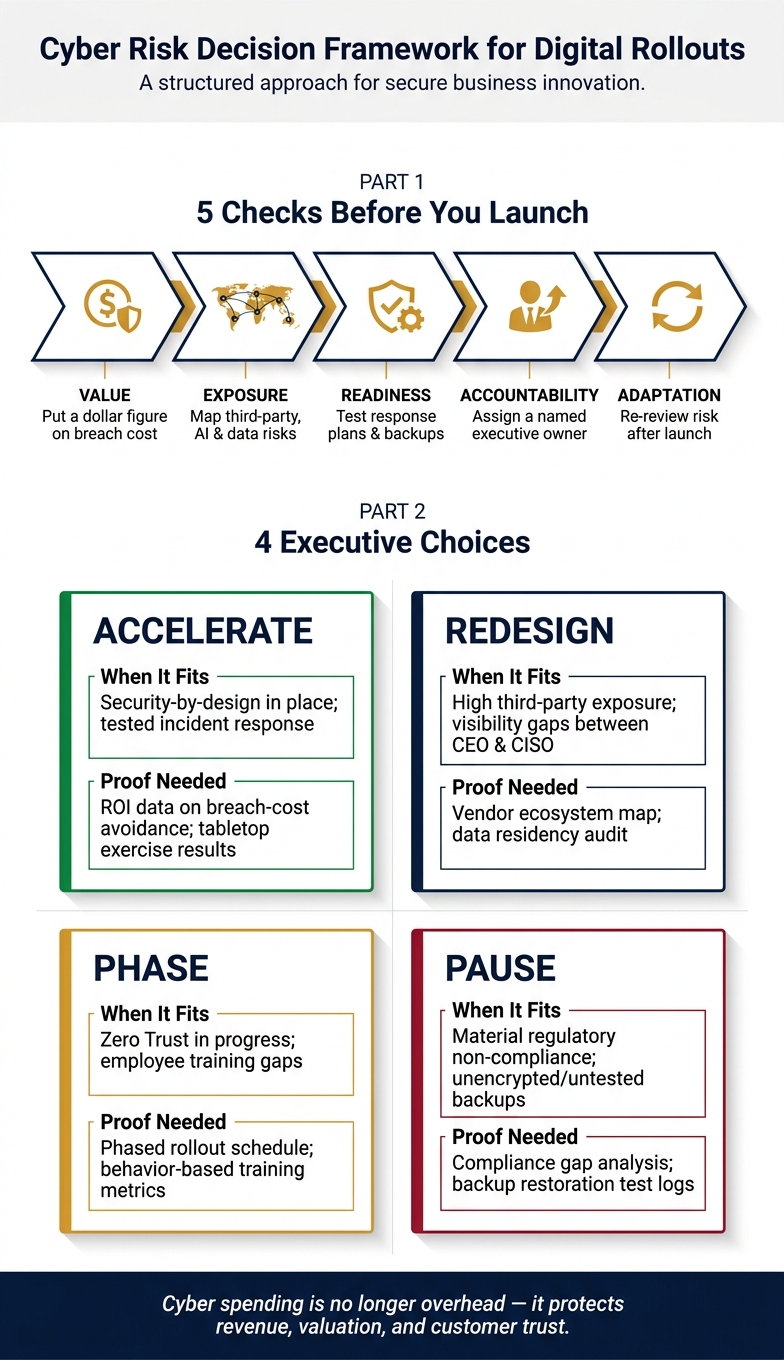
Cyber Risk Decision Framework: 4 CEO Choices Before a Digital Rollout
Cyber risk now shapes decisions in the CEO’s office, the boardroom, and investor meetings because every digital move touches growth, valuation, and disclosure. After the rollout lessons above, the issue isn’t whether to move ahead. It’s how much risk the launch can carry.
Five checks help leaders make that call. Value: Put a dollar figure on what a breach could cost. Exposure: Map third-party, AI, and data risks. Readiness: Make sure response plans and backups have been tested. Accountability: Assign a named executive to each control and each recovery need. Adaptation: Review the risk picture again after launch as vendor access and data flows shift.
Those five checks point to four choices: accelerate, redesign, phase, or pause.
| Executive Choice | When It Fits | Proof Needed |
|---|---|---|
| Accelerate | Strong security-by-design in place; AI/automation integrated into defense; tested incident response | ROI data on breach-cost avoidance; successful tabletop exercise results |
| Redesign | High third-party exposure; lack of privacy by design; visibility gaps between CEO and CISO | Full vendor ecosystem map; data residency audit; updated risk quantification |
| Phase | Zero Trust implementation in progress; employee training gaps; emerging AI threats | Phased rollout schedule for identity controls; behavior-based training metrics |
| Pause | Material regulatory non-compliance; unencrypted or untested backups; high fraud success rates | Compliance gap analysis; backup restoration test logs; out-of-band verification protocols |
CEOs, boards, and investors may look at the same evidence, but they use it for different calls:
- CEOs focus on speed and whether the business can move now.
- Boards focus on oversight and whether the company is taking the right precautions.
- Investors focus on downside protection and what could hurt value.
Key Takeaways for CEOs, Boards, and Investors
Cyber risk now helps decide which digital bets move ahead and which ones wait. The strongest leaders build security into transformation early, not as a box to check, but as a condition for growth that can last.
Boards and investors want proof. They want tested resilience, clear executive ownership, and risk measured in dollars. Leaders who handle this well tend to ask sharper questions before launch, then come back to those same questions after launch as conditions change.
For peer discussion on cyber governance and growth trade-offs, visit CEO Hangout.
FAQs
How should a CEO quantify cyber risk before launch?
Translate technical vulnerabilities into financial terms tied to business outcomes. Use frameworks like FAIR and metrics such as Annualized Loss Expectancy (ALE) to estimate the yearly financial impact of specific threats.
Back that up with Loss Exceedance Curves and Monte Carlo simulations. These methods help you move from “this could happen” to “this could cost us about $X per year under likely conditions.”
Before you put numbers on the board, make sure the basics are solid:
- Your asset inventory is current
- Your data classification is defined and used
- Key controls are in place, such as encryption, least-privilege access, and third-party audits
If those pieces are missing, the math may look clean while the risk picture stays fuzzy.
When is it smarter to phase or pause a rollout?
It’s often smarter to phase or pause a rollout when problems show up early, or when big changes – like new threats, advances in tech, or shifts in day-to-day operations – make current controls less effective.
Leaders should review projects through a security lens before launch and make sure the business case is solid. A step-by-step approach, using agile methods, helps teams test as they go and cut disruption. If success metrics or business alignment aren’t clear, pausing gives the team room to adjust and protect stability.
What proof do boards and investors expect before approval?
Boards and investors want proof that cybersecurity is being handled as a business function, not stuck inside a technical silo.
That means reporting needs to do more than list security issues. It should connect technical risk to financial and operational impact. And if a risk is accepted, there should be a written reason for that decision, along with the controls that are in place.
They also want proof that those controls actually work. In practice, that usually includes independent audits, penetration test summaries, response-time metrics, and dashboards that show trends, benchmarks, and escalation protocols.