

Cross-functional leadership means getting departments to deliver one shared result – even when no one reports to you. I start with a one-page charter: the outcome, deadline, sponsor, decision owner, and resource commitments.
My approach comes down to five steps:
- Build the team: Choose people with the skills, access, and time to do the work.
- Secure commitments: Understand each function’s goals and agree on what it can deliver.
- Set decision rules: Name who decides, who must approve, and when the sponsor steps in.
- Handle conflict: Compare options against shared criteria – not departmental preferences.
- Track results and hand off: Use three to five outcome measures, fix missed commitments, and confirm who owns the work after the team closes.
The goal isn’t more meetings. It’s <u>clear ownership from the first commitment through the final handoff</u>.
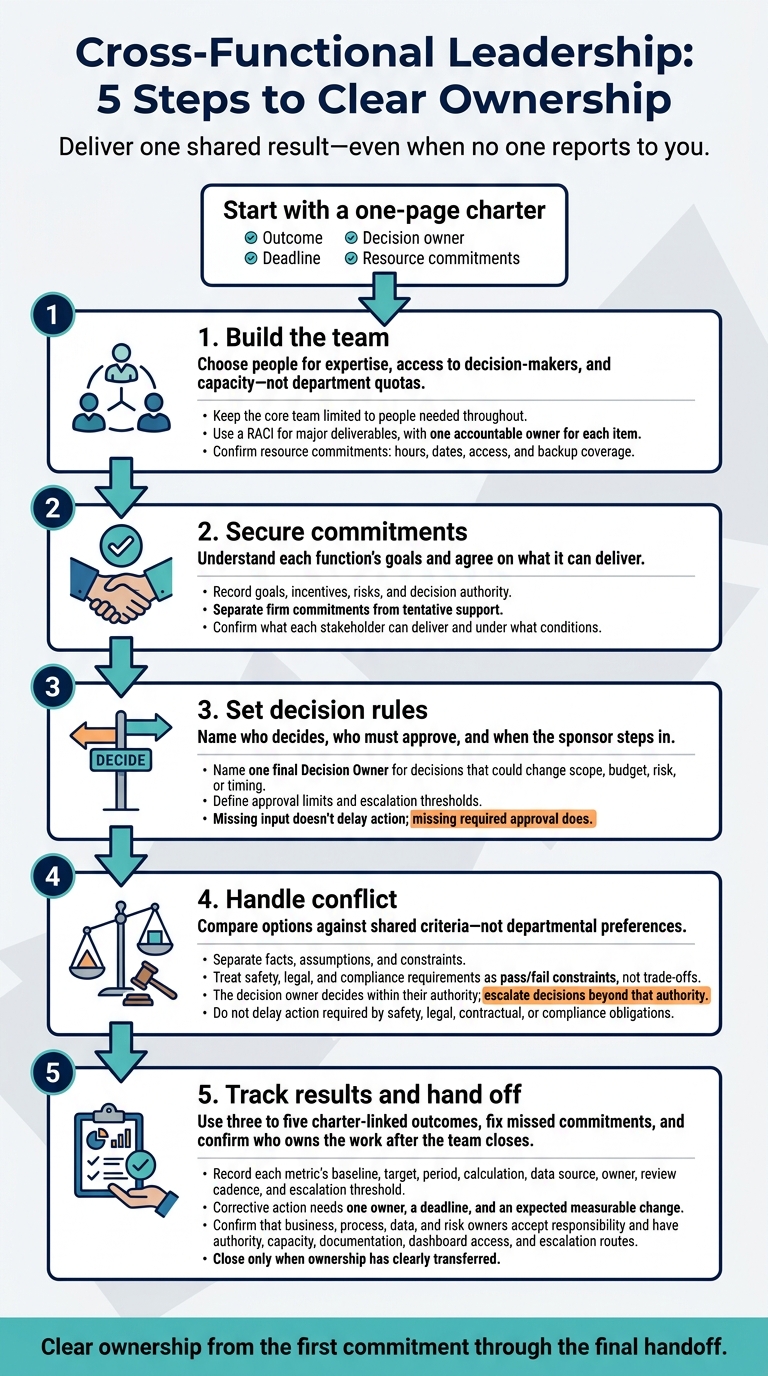
Cross-Functional Leadership: 5 Steps to Clear Ownership
How to Manage a Cross-Functional Team
sbb-itb-2fdc177
Build the Cross-Functional Team
With the charter set, build the smallest team that can deliver it. Choose members for expertise, access to decision-makers, and capacity – not department quotas. You won’t have direct authority over functional teams, so select people who can secure decisions, resources, or data. Keep the core team limited to people whose work is needed throughout; bring in specialists when their input is needed.
Once you’ve selected the core team, agree on success criteria before work begins.
Define the Charter and Success Criteria
Spell out what’s outside the scope, along with constraints, dependencies, milestones, and the evidence needed to confirm completion. Set milestones based on actual lead times, staffing, and delivery capacity. Review these terms with affected functional managers so their teams don’t inherit commitments they can’t meet.
A launch is ready only when each function meets its named threshold.
Assign Roles and Confirm Capacity
Use a RACI for major deliverables, with one accountable owner for each item. Name an initiative leader to coordinate dependencies, keep the plan current, and escalate blockers.
Functional managers remain responsible for people, standards, and capacity. The sponsor resolves trade-offs beyond the team’s authority. Get written resource commitments that cover hours, dates, access, and backup coverage. If capacity falls short, ask the sponsor to adjust scope, timing, resources, or priorities.
Set Team Norms and Track Commitments
Agree on clear working rules: acknowledge requests within one business day, document decisions within 24 hours, and escalate blockers that threaten to delay a milestone by more than three business days.
Use one shared tracker for deliverables, owners, deadlines, dependencies, risks, and next actions. In productive meetings, discuss changes and blockers instead of reading every row aloud. Require preparation, don’t allow interruptions, and end each meeting with named commitments.
Invite quieter members to voice concerns, and treat early error reports as useful information. These norms support psychological safety. Challenge assumptions, not people.
Lead Without Direct Authority
Understand Stakeholder Goals and Constraints
Cross-functional leadership starts with knowing what each function needs to succeed. Use the charter to guide one-on-one conversations with key stakeholders before asking for support. Record their goals, incentives, risks, decision authority, and informal influence. Ask what would make the work worth doing – and what could cause it to fail. Tie requests to shared outcomes while making the costs clear: sales growth also affects fulfillment capacity, margin, and cash flow.
Build Trust and Agree on Commitments
Bring evidence, explain your assumptions, and involve stakeholders before the plan is final. Offer practical help, whether that means supporting measurement or taking coordination work off a manager’s plate. Trust grows through useful expertise and dependable follow-through.
Separate firm commitments from tentative support. Confirm what each stakeholder can deliver and under what conditions. Make it clear that owning the initiative means coordinating dependencies, not telling specialists how to do their jobs. If departmental targets discourage cooperation, work through the incentive conflict with the functional manager. Don’t ask employees to ignore their goals.
These commitments provide a basis for the decision rules and meeting schedule that come next.
Seek Sponsor and Executive Peer Support
Stop persuading when the decision requires authority you don’t have. Decisions involving multiple budget owners, headcount changes, unresolved risk trade-offs, or conflicting executive priorities need sponsor judgment. Present the decision, options, business impact, recommendation, and deadline. Ask the sponsor to resolve the trade-off – not manage routine task completion.
Executive peers can help you test assumptions and clarify how you frame an escalation. Only your organization’s authorized leaders decide budgets, resources, and priorities.
Once escalation paths are clear, define who owns decisions and how they’re documented.
Define Decision Rights and Meeting Formats
Assign Decision Owners and Approval Limits
Once commitments are set, spell out who can decide, who must approve, and when to escalate. Use the charter to name one final Decision Owner for every decision that could change scope, budget, risk, or timing. In a shared register, name who recommends, provides input, gives required approval, executes, and receives updates.
Keep responsibility for execution separate from authority to change scope, budget, risk tolerance, or customer commitments. In a RAPID-style model, required approval covers defined legal, regulatory, safety, or policy matters – not every stakeholder’s preference.
Set deadlines for recommendations, input, and decisions. After the input cutoff, the owner decides. Missing input doesn’t delay action; missing required approval does. Document limits for budget, scope, risk, and customer impact, with numeric thresholds that trigger sponsor approval.
With authority clear, match each decision to the right forum.
Choose the Right Meeting Format
Start with weekly workstream reviews and monthly executive reviews, then adjust for risk and pace. Send evidence and proposals in advance. Every invitation should state the required output, decision owner, pre-read materials, and each attendee’s role. Keep routine status updates out of executive reviews.
| Format | Purpose | Required participants | Decision authority | Cadence | Expected output |
|---|---|---|---|---|---|
| Asynchronous update | Share progress, risks, and input requests | Workstream leads and affected stakeholders | Existing delegated authority | Weekly or when milestones change | Written update and flagged decisions |
| Working session | Develop options | Relevant specialists and task owners | Designated owner, within limits | Weekly or as needed | Recommendation and assigned work |
| Decision forum | Choose among prepared options | Decision Owner, recommender, required approvers, and necessary input providers | Named Decision Owner | Biweekly or monthly; sooner if needed | Decision, rationale, and execution owner |
| Escalation meeting | Resolve items beyond the team’s authority | Sponsor, affected executives, Decision Owner, and relevant experts | Authorized sponsor or executive | When a threshold or deadline is breached | Resolution or explicit next step |
Log Decisions and Assign Follow-Up
After each forum, record the outcome in one shared decision log so agreements lead to action. Include the question, options, criteria, recommendation, final decision, rationale, Decision Owner, required approvers, and affected teams. Add the effective date, execution owner, dependencies, deadline, and review trigger so everyone knows what changes and when.
Reserve the last 5–10 minutes to assign action owners, set deadlines, and confirm what belongs in the log. Share the entry with affected stakeholders within 24 hours, including anyone who was absent. Reopen a decision only when there’s new evidence, changed constraints, or a set review trigger.
Resolve Conflict Across Functions
Find the Source of Disagreement
When a decision forum stalls, identify the source of disagreement before escalating. Is it about priorities, execution, resources, or trust and communication? Ask what outcome each function is trying to protect, then separate facts, assumptions, and constraints.
Use the existing decision log, decision owner, and criteria to distinguish facts from preferences. Check role boundaries and capacity before treating resistance as a personal issue.
If trust or communication is the problem, hold separate listening conversations as needed. Then bring everyone back to the shared forum with clear commitments and accountability.
Compare Options Against Shared Criteria
Restate the shared outcome and the decision the team needs to make. Ask each function to explain its interests, and agree on criteria before scoring options. Score only the real options. Treat safety, legal, and compliance requirements as pass/fail constraints, not trade-offs.
Test the scores against evidence; don’t let the total make the decision. The decision owner makes the call within their authority and records how material objections were addressed.
Turn the choice into clear implementation responsibilities, including changes to handoffs or capacity commitments. Once the owner decides, move into execution and track commitments in the shared log. Participants should support the decision unless new information emerges.
Escalate Decisions That Need Sponsor Input
Escalate only after the team has tested the issue against shared criteria and authority limits. Set a time limit for unresolved issues based on risk and the cost of delay.
Use a short test only when uncertainty can be measured and the choice can be reversed. Escalate promptly when negotiation can’t resolve the issue. Don’t wait when safety, legal, contractual, or compliance obligations require immediate action.
When the team lacks authority, send the sponsor the decision needed, viable options, recommendation, business impact, authority gap, and deadline – not complaints about another function. Keep unaffected work moving while the sponsor reviews the issue.
Track Results and Improve Execution
Build a Shared Outcome Scorecard
Once decisions are logged, check whether they deliver the intended business result. Choose three to five charter-linked outcomes, such as gross margin, retention, on-time delivery, revenue, cost-to-serve, or cycle time. Pair each with leading signals: adoption, forecast accuracy, first-pass quality, capacity, risk exposure, decision latency, overdue dependencies, and commitment reliability.
Use paired metrics so one function can’t improve its numbers by passing problems to another.
Treat the scorecard as a measurement system, not another task tracker. For every metric, record its baseline, target, period, calculation, data source, owner, review cadence, and escalation threshold.
If the business goal is to reduce delivery time, establish the median and 90th-percentile cycle time for the previous 8–12 weeks so averages do not hide long delays.
Track commitment reliability and preserve original due dates. That way, no one can quietly reset the performance record.
Use Performance Signals to Guide Action
Review execution signals on the operating cadence and business outcomes monthly. Set thresholds before problems arise:
A critical dependency more than five business days late can trigger owner review, while forecast variance above 10% can trigger a recovery plan.
Match these thresholds to business risk, and watch for patterns:
Rising overtime may conceal a capacity shortage, while completed milestones alongside rising defects suggest that delivery is outpacing quality.
For each threshold breach, have the decision owner define a corrective action with one owner, a deadline, and an expected measurable change. Escalate when the action requires authority they don’t have. Close it only when performance improves.
Keep delivery and benefits separate: a finished deliverable proves completion, not value. Assign a benefits owner in the function that will receive the value, along with a verification date. Accountability should continue after delivery.
Review Team Setup and Transfer Ownership
Once execution stabilizes, use the same data to check whether the team setup still fits the work.
At major milestones, run a brief continue / stop / start / clarify retrospective and choose two or three changes. Repeated failures call for changes to the charter, roles, decision rights, capacity, or cadence – not more reminders.
Before closing the team, confirm that named business, process, data, and risk owners have accepted responsibility. Check that they have the authority, capacity, documentation, dashboard access, and escalation routes they need. Verify gains against the baseline, owner, and due date.
Conclusion: Executive Implementation Checklist
Use this four-step checklist to move from launch to handoff while keeping outcomes, decisions, and ownership on track.
- Before launch: Approve the charter and success measures. Name the sponsor, leader, and functional representatives, and confirm capacity, budget, and constraints. Set these before work starts.
- At kickoff: Agree on how to handle dissent, response deadlines, and missed commitments. Record decision owners, approval limits, and triggers for escalating to the sponsor. Map dependencies to the functions that own them, and confirm ownership in writing.
- During execution: Review commitments, risks, decisions, and results. Resolve disagreements early using shared criteria. When priorities change, renegotiate capacity instead of relying on hidden overtime. Build trust by communicating changes early and keeping commitments.
- At close: Check outcomes against the baseline and target. Have Finance validate calculations and separate realized gains from projected benefits. Record lessons as changes to future practice, and transfer remaining obligations to receiving owners. Before release, confirm documentation, training, readiness, and a review date. Close only when ownership has clearly transferred.
FAQs
How do I rebuild trust after a missed commitment?
Own the mistake directly, without excuses. Take responsibility by talking openly about the challenge and admitting when you don’t have all the answers.
Have an honest conversation soon after the mistake to clarify what happened, agree on goals, and give everyone space to be heard. Being open about what went wrong shows that honesty matters more than perfection. It also helps others feel safe speaking openly, creating a basis for rebuilding trust.
What if my sponsor won’t resolve conflicting priorities?
Bring the conversation back to shared organizational goals. Instead of focusing on individual positions, look at the conflicting incentives and unmet needs behind the disagreement. Mediation can help everyone agree on the problem and the outcomes they want.
If tight deadlines or entrenched interests block agreement, ask leadership to step in or assign the decision to a designated authority so the project can move forward. Keep communication consistent and transparent to help everyone stay aligned.
How can I prevent cross-functional decision bottlenecks?
Align teams around shared, measurable outcomes. Use a RACI (Responsible/Accountable/Consulted/Informed) to clarify ownership and make sure everyone knows who makes each decision.
Hold weekly updates focused on blockers and monthly reviews to spot roadblocks early. Record action items with owners and due dates. Work from shared, trusted metrics and map dependencies so teams can see handoffs and resolve exceptions quickly.