

If I had to sum this up in one line: ISSB climate reporting is a finance and governance job, not a PR exercise.
If I’m a CEO, here’s what matters right away:
- IFRS S1 tells me how to report sustainability-related issues that could affect company value.
- IFRS S2 applies that same model to climate, including Scope 1, Scope 2, and Scope 3 emissions.
- The work falls into four areas: governance, strategy, risk management, and metrics and targets.
- As of January 1, 2026, 21 jurisdictions had adopted ISSB standards on a voluntary or mandatory basis, and by 2026, 39 jurisdictions were moving toward adoption or other use.
- In the U.S., rules still vary. California SB 253 starts emissions reporting in 2026 for covered companies, while the SEC climate rule has faced delays and legal uncertainty.
That means I can’t treat this like a once-a-year report. I need to know who owns the work, which climate risks affect cash flow, how emissions numbers are built, and whether every figure can be traced back to source records.
Here’s the short version of what a CEO needs to do:
- Put an effective leader in charge
- Give the board a clear oversight role as a leader
- Tie climate risks and opportunities to budgets, capex, and forecasts
- Build controls for emissions and other climate data
- Test assumptions before the first filing cycle
A simple way to think about it: S1 is the base rulebook; S2 is the climate layer on top. If I mix them together too early, reporting gets messy. If I treat climate data like finance data, the job gets a lot clearer.
ISSB Sustainability Standards Explained (S1 & S2 Made Simple)
sbb-itb-2fdc177
Quick comparison
| Standard | What it covers | What I need to do |
|---|---|---|
| IFRS S1 | Material sustainability-related risks and opportunities that may affect cash flow, financing, or cost of capital | Set scope, decide material topics, document judgments, and build reporting controls |
| IFRS S2 | Material climate-related risks, opportunities, emissions, and targets | Track climate risk, build emissions data systems, set baselines, and report progress |
My takeaway: the main test is simple. Could an investor, director, or auditor trace a climate statement back to controlled evidence? If not, the gap is a management problem first.
The rest of the article turns that idea into a plain action plan for CEOs.
IFRS S1 and IFRS S2 explained before you build a plan
IFRS S1 is the base framework. IFRS S2 sits on top of it and deals with climate. So the usual flow is simple: start with IFRS S1, then add IFRS S2.
IFRS S1: General sustainability-related financial disclosures
IFRS S1 requires companies to disclose sustainability-related risks and opportunities that could materially affect cash flows, financing, or cost of capital. In plain English, if a sustainability issue could change the company’s financial picture in a meaningful way, it belongs in the report.
There’s an important catch here. If a sustainability matter is material, you still need to disclose it even when the data is hard to measure. In that case, explain how you estimated it, what assumptions you used, and where the limits are.
IFRS S2 follows this same basic idea, but applies it to climate.
IFRS S2: Climate-specific disclosures
IFRS S2 applies the IFRS S1 framework to climate risks, opportunities, and emissions. It covers physical risks, transition risks, and climate-related opportunities across the value chain.
It also requires disclosure of Scope 1, Scope 2, and Scope 3 emissions, subject to the standard’s rules and transition reliefs. If your company has climate targets, you need to disclose the scope of those targets, the baseline, the method used, milestones, progress so far, and the plan for getting there.
There’s also a first-year relief for new adopters. They may delay Scope 3 reporting in year one, but that’s only temporary. It is not a permanent exemption.
IFRS S1 vs. IFRS S2: side-by-side comparison
Use this table to separate the core framework from the climate layer.
| Feature | IFRS S1 | IFRS S2 |
|---|---|---|
| Scope | Material sustainability-related risks and opportunities | Material climate-related risks and opportunities |
| Why it exists | Explain how sustainability matters could affect cash flows, financing, and cost of capital | Explain how climate matters could affect those same financial outcomes |
| How it fits | Provides the general reporting structure and requirements | Builds on IFRS S1 with climate-specific requirements |
| What it covers | Governance, strategy, risk management, metrics and targets, judgments, assumptions, and comparatives | Climate governance, physical and transition risks, opportunities, Scope 1–3 emissions, and climate targets |
| CEO action | Identify material issues, set reporting boundaries, establish data controls | Build climate data systems, set emissions baselines, and track progress against climate targets |
| Reporting approach | Apply to material sustainability-related information | Apply with IFRS S1, not as a separate standalone system |
A good way to think about it: IFRS S1 gives you the reporting skeleton, and IFRS S2 adds the climate muscle on top. If teams mix the two together too early, things can get messy fast. This side-by-side view helps keep the base rules separate from the climate add-on.
How to apply the four ISSB reporting areas to your business
Governance and strategy: board oversight, management roles, and business impact
The first call a CEO needs to make is simple, but teams often skip it: who owns this? Decide whether climate oversight sits with the full board, the audit committee, the risk committee, or a dedicated sustainability committee. Then write it down. Spell out the mandate, how often the group meets for productive sessions, what information it gets, and what know-how it needs. Keep the lines clear between the board, the executive team, finance, sustainability, and risk.
Next, give named executives clear ownership across the business. In many companies, a workable split looks like this:
- The CFO owns financial effects and reporting controls
- The COO owns operational resilience
- Procurement owns supplier and Scope 3 data
- Legal and compliance track regulatory exposure
- Sustainability coordinates emissions methodology
The CEO’s job is to make sure these teams use the same definitions and stay in sync.
On strategy, this work has to go past the yearly budget cycle. IFRS S2 requires companies to explain how climate risks and opportunities affect the business model, value chain, financial position, and cash flows across short-, medium-, and long-term horizons. In plain terms, that means mapping key facilities, products, services, suppliers, logistics routes, customers, financing sources, and markets. From there, identify where physical risks, like flooding or heat stress, and transition risks, like carbon pricing or shifts in customer demand, could hit performance.
Risk management: how to bring climate into your existing risk process
The most practical step is not to build a separate climate risk register from scratch. Map climate risks into your current enterprise risk management process. Your process should identify, assess, prioritize, monitor, and manage physical risks, transition risks, and climate-related opportunities. Use the same setup your team already uses for operating or financial risks, with one materiality method across functions.
For each risk or opportunity, the record should show the owner, affected assets or business units, time horizon, likelihood, potential financial effect, current controls, response plan, and an escalation trigger. That last part matters more than many teams think. A solid rule of thumb: escalate when a climate issue threatens material revenue or cash flow, affects a major asset or supplier, calls for large capital spending, or creates regulatory or financing exposure.
CDP‘s 2025 assessment found that 83% of companies disclosed against all aligned risk-management questions, a 25% increase from the prior year. That progress is encouraging, but it also shows something important: it’s much easier to describe a process than to back it up with dependable numbers.
Metrics and targets: emissions data, assumptions, and progress tracking
The same CDP data shows that only 31% of companies disclosed against all aligned climate-metrics questions in 2025. That gap makes the problem pretty clear: measurement is still the hard part.
Start with an emissions inventory that has clear organizational boundaries, data owners, source records, calculation methods, and review controls. Scope 1 covers direct emissions from sources the company owns or controls. Scope 2 covers purchased energy. Scope 3 covers the rest of the value chain, including all 15 categories defined in the Greenhouse Gas Protocol Corporate Value Chain Standard. If primary data is missing, document the estimation method, the emission factors used, and the plan to improve data quality over time. Calling an estimate a precise measurement is a disclosure risk.
Each climate target should come with a baseline year, target year, interim milestones, the methodology used, a named executive owner, and a funding plan. IFRS S2 requires disclosure of whether a target is gross or net, which gases and scopes are covered, and how progress is tracked. And if climate assumptions affect margins or cash flow in a material way, they belong in the budget and forecasting process, not only in the sustainability report. If any climate metrics are tied to executive pay, those metrics need controlled, auditable definitions and clear rules for restatements.
How to connect climate disclosures to enterprise value and internal reporting
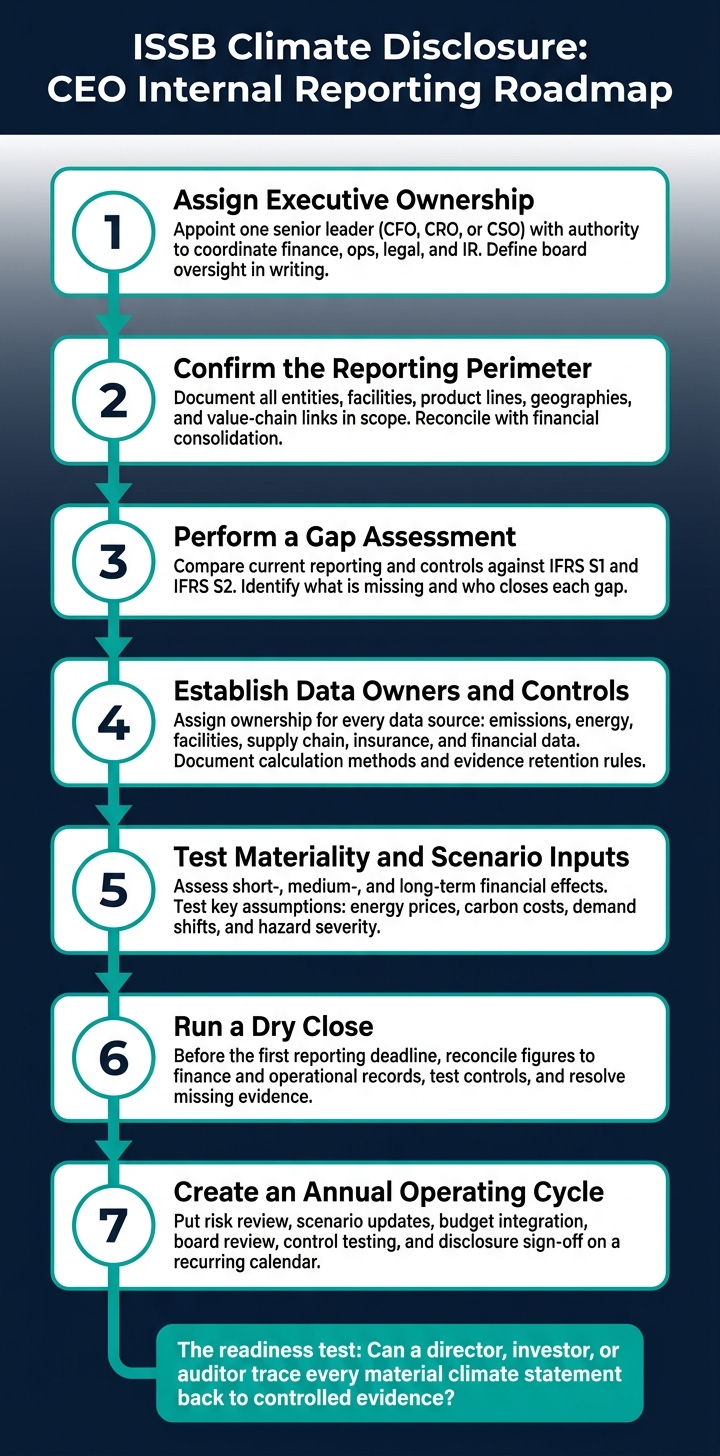
ISSB Climate Disclosure Readiness: 7-Step Action Plan for CEOs
After governance, risk, and metrics, the next step is to show how climate disclosures move into enterprise value and internal reporting.
Link physical risks, transition risks, and opportunities to financial outcomes
ISSB reporting is about enterprise value: can a climate issue affect cash flow, financing, or cost of capital over the short, medium, or long term? If the answer is yes, it belongs in your disclosure and in your financial planning.
Map each material climate issue to a financial outcome. Physical risk can increase insurance costs, disrupt suppliers, and lead to unplanned capex. Transition risk can increase operating costs, strand assets, and squeeze margins. Opportunities can increase revenue, cut energy costs, and improve access to capital.
One business activity can face both kinds of pressure at the same time. A data center is a good example. It may face physical risk from extreme heat that increases cooling costs and puts uptime at risk. At the same time, it may face transition risk from tighter energy standards or customer demand for lower-carbon computing.
For climate-related opportunities, use the same discipline you use for risks: document the financial effect, assumptions, and owner.
Climate issue to financial outcome: a comparison table
Use the same logic for every material climate issue: identify the issue, trace the financial effect, assign an owner, and attach the data.
| Climate issue | Likely financial pathway | Accountable executive | Data needed | Response |
|---|---|---|---|---|
| Physical risk | Property damage, downtime, supply disruption, higher insurance, unplanned capital spending | COO, chief risk officer, facilities or supply-chain leader | Facility locations, hazard exposure, downtime history, insurance premiums, supplier sites | Harden or relocate assets, diversify suppliers, increase inventory buffers, secure coverage |
| Transition risk | Higher compliance and operating costs, stranded assets, margin pressure, demand loss, higher cost of capital | CFO, chief risk officer, legal, product or commercial leader | Emissions data, regulatory exposure, carbon-price assumptions, product profitability, asset lives | Redesign products, improve efficiency, retire or repurpose assets, revise capital plans, engage lenders |
| Climate-related opportunity | New revenue, lower energy costs, improved margins, stronger customer retention, better financing access | CEO, chief commercial officer, CFO, product or R&D leader | Customer demand data, product economics, R&D costs, expected margins, avoided costs, incentive eligibility | Develop low-emissions products, invest in efficiency, enter new markets, pursue green financing |
This table should be a living document tied to your risk register, financial model, and capital plan, not a one-time exercise for the sustainability report.
How to build your internal reporting plan
Once the financial link is clear, build the reporting process around it. The goal is to treat ISSB-aligned climate disclosure as an integrated reporting and internal-control program, not just an annual publication.
1. Assign executive ownership
Appoint one senior accountable owner – CFO, chief risk officer, chief sustainability officer, or another senior leader – with the authority to coordinate finance, operations, procurement, legal, risk, and investor relations. Define board or committee oversight in writing.
2. Confirm the reporting perimeter
Document the entities, facilities, product lines, geographies, and value-chain links in scope. Reconcile this perimeter with financial consolidation and operational risk reporting.
3. Perform a gap assessment
Compare current reporting and controls against IFRS S1 and IFRS S2. Be specific about what is missing and who is responsible for closing each gap.
4. Establish data owners and controls
Assign ownership for every data source – emissions, energy, facilities, supply chain, insurance, customer, and financial data. Document calculation methods, review procedures, and evidence retention rules as part of the reporting cycle, not as a separate sustainability exercise.
5. Test materiality and scenario inputs
Assess short-, medium-, and long-term financial effects. Test key assumptions – energy prices, carbon costs, demand, and hazard severity – and document the actions assumed.
6. Run a dry close
Before your first reporting deadline, run a dry close. Reconcile figures to finance and operational records, test controls, and resolve missing evidence before it turns into a disclosure problem.
7. Create an annual operating cycle
Put risk review, scenario updates, budget integration, board review, control testing, and disclosure sign-off on a recurring calendar.
Use peer input only to test your process, not to replace company-specific controls or board-approved reporting.
Conclusion: CEO decisions that determine ISSB readiness
Once the reporting plan is in place, the CEO has to turn that plan into day-to-day discipline.
ISSB readiness is not just a reporting task. It is a management call. These four areas already belong to the CEO’s decision-making. The key difference is simple: is climate built into that framework, or is it pushed off to a sustainability team that doesn’t have much authority?
A quick way to judge readiness is to look at three things: executive ownership, board oversight, and data control.
Before signing off on the plan, a CEO should be able to answer seven questions:
| Decision area | The question to answer |
|---|---|
| Ownership | Is one executive accountable for the full program? |
| Board oversight | Does one committee have a clear remit, cadence, and approval role? |
| Material risks | Have physical and transition risks been prioritized and tied to business prospects? |
| Data controls | Can every key figure be traced to its source, owner, and method? |
| Emissions | Are Scope 1, Scope 2, and relevant Scope 3 calculations reproducible and supported by retained evidence? |
| Capital alignment | Are material climate issues built into budgets, forecasts, capex, and asset values? |
| Open items | Is there a written log of open legal, regulatory, methodology, and assurance questions? |
Even with uncertainty in U.S. rulemaking, the readiness test stays the same. U.S. rulemaking remains unsettled, and that uncertainty is a reason to plan, not a reason to sit still. As of 2026, 39 jurisdictions were progressing with adoption or other use of ISSB Standards. Companies with international subsidiaries, foreign lenders, or large institutional investors may face ISSB-aligned information requests no matter what the SEC ends up requiring.
The practical test is straightforward: could a director, investor, or auditor trace a material statement in your climate disclosure back to controlled evidence? If the answer is no – or even not yet – the gap starts as a management issue before it turns into a reporting issue. Targets without baselines, emissions figures without retained activity data, and board minutes that show presentations but not decisions all point to the same thing: the program needs more structure, not more narrative.
CEOs who treat ISSB readiness as part of how the company manages risk, capital, and performance will be in a stronger position than those who treat it like a once-a-year publication exercise. The standards are built to communicate information that could affect company prospects, which means the work belongs inside the business.
FAQs
How do I decide what is material under IFRS S1 and IFRS S2?
Under IFRS S1 and IFRS S2, information is material when sustainability-related risks or opportunities could reasonably affect the decisions people make using your general-purpose financial reports.
A materiality assessment helps you figure out which issues matter most to stakeholders and fit your business model. In plain English: it keeps your reporting focused on what matters, instead of trying to cover everything at once. It also helps make disclosures more transparent and tied to your company’s long-term viability.
What if our Scope 3 data is incomplete or estimated?
If your Scope 3 data is incomplete or based on estimates, focus on being clear about what you know and improving the data over time. Don’t wait for perfect numbers before you report.
A common starting point is a spend-based approach. From there, you can improve accuracy over time by moving toward activity-based data or supplier-specific data. Just be clear about the method you used and any limits in the data, so stakeholders can understand the picture and trust what you’re sharing.
Who should lead ISSB reporting inside the company?
ISSB reporting should be led by the CEO, in close partnership with the Chief Sustainability Officer. The CEO sets the direction, assigns resources, works with stakeholders, and helps make sustainability part of the company’s core strategy.
Risk, finance, and regulatory teams also need to stay aligned. That means using the same definitions, the same tools, and the same working assumptions. At the leadership level, governance should be put in place to support compliance over the long term.