

A major decision can be legal and profitable – and still damage trust, sales, hiring, financing, and company value. That is the core point. If I wait to think about reputation after approval, I am already late.
Here’s the short version:
- Reputation risk is a business risk, not just a communications problem
- Big decisions need a simple review before approval
- Ownership, escalation rules, and approval gates must be clear
- I need to test stakeholder harm, legal issues, trust loss, and reversibility
- The job does not end at approval – it shifts to monitoring, crisis signals, investor concerns, and employee trust
- A standard decision record makes the process easier to repeat
A few numbers show the gap. In 2026, 82% of respondents in a WTW survey ranked reputation among their top three to five risks, but only 49% said they knew how stakeholders viewed their organization. Aon found that just 12% of organizations had quantified reputation risk.
If I boil the article down to one rule, it’s this: before I approve a layoff, deal, launch, pricing shift, vendor change, or market move, I should ask who may be harmed, how they may react, and what that could cost in dollars, trust, and room to operate.
The piece lays out a plain process:
- screen the decision early
- map the people affected
- test downside scenarios
- check whether controls work in practice
- choose to avoid, reduce, defer, transfer, or accept the risk
- record the rationale
- track warning signs after launch
It also makes one point that leaders often miss: bad press is usually the result, not the root problem. The root problem is often weak testing, poor conduct, weak data controls, uneven treatment, or a gap between what the company says and what it does.
For me, the takeaway is simple: good governance on reputation risk means making better decisions before they become public problems.
Build the Governance Model Before Final Approval
This starts with governance.
Bring reputation review into the forums you already use: investment committees, strategic planning, capital allocation, M&A diligence, and workforce reviews. One shared process is faster, simpler, and easier to follow than running a second review track on the side.
Assign Clear Accountability Across the Board, CEO, and Control Functions
Reputation risk needs a named owner at each level. If ownership is fuzzy, it usually means no one owns it. The business owner is accountable for the decision itself, the business case behind it, stakeholder effects, controls, and execution.
In practice:
- Board: Approves the organization’s reputation-risk appetite, oversees material exposures, tests management’s assumptions, and reviews major decisions that could affect the company’s long-term operating license.
- CEO: Owns the executive tradeoff between opportunity and reputation exposure and makes sure no major decision skips the agreed governance process.
- Executive committee: Settles cross-functional conflicts, approves decisions above management thresholds, and keeps the process steady across business units.
- Control functions (legal, compliance, risk, finance, HR, investor relations, communications): Test assumptions, check controls, and record conclusions. Their role is to surface what the business owner may have missed and decide whether controls are enough – not to take over line ownership.
Set Risk Appetite, Escalation Triggers, and Approval Thresholds
A sound risk appetite statement should spell out three things: the kinds of reputational harm the organization will not knowingly accept, the level of exposure it may accept for a defined business benefit, and the conditions that must be in place before that exposure is accepted. A simple way to organize harms is to use three buckets:
- Stakeholder harm – customers, employees, communities, or suppliers
- Legal and ethical breaches – regulatory violations, misleading communications, discrimination, or data misuse
- Trust erosion – loss of confidence among investors, public authorities, or the workforce
Each category should tie back to measures you can track. The four measures that tend to help most in decision-making are:
- Number and severity of substantiated complaints
- Employee-trust deterioration
- Customer attrition
- Potential effect on material revenue or financing
Escalation should depend on the type and seriousness of the exposure, not on whether the press has picked up the story yet. Good triggers include likely harm to customers or employees, possible legal or regulatory breaches, high public visibility, low reversibility, and disagreement among control functions. Set the escalation point below the formal risk limit. That gap gives management room to redesign or pause a decision before it turns into a crisis.
Use a simple authority matrix so each major decision has one owner, one approval route, and one escalation trigger. These are the decisions where reputation exposure most often shifts value, trust, or operating freedom.
| Decision type | Accountable owner | Required reviewers | Approval body | Required documentation | Escalation trigger |
|---|---|---|---|---|---|
| Strategic plan or market entry | Business-unit president or strategy leader | Risk, legal, compliance, finance, communications, HR where relevant | Executive committee; board for material strategy changes | Stakeholder map, scenario analysis, risk rating, controls, communications plan | Regulatory uncertainty, community or political sensitivity, irreversible investment, or exposure outside appetite |
| Major capital project | CFO or sponsoring executive | Finance, risk, legal, procurement, communications | Investment committee; board for threshold-level capital | Business case, downside cases, stakeholder impacts, approval record | Material cost or schedule risk, environmental or community concerns, or unresolved control gaps |
| M&A or strategic partnership | CEO or corporate development leader | Legal, compliance, risk, finance, HR, communications, investor relations | CEO and board or designated board committee | Due-diligence findings, culture assessment, conduct history, integration plan | Significant undisclosed liabilities, controversial counterparty, cultural incompatibility, or inability to exit |
| Workforce reduction or site closure | CHRO and business owner | Legal, finance, risk, communications, employee relations | CEO or executive committee; board notification when material | Fairness analysis, alternatives considered, employee and community plan | Disproportionate impact, labor-law risk, safety concern, or high local dependence |
| Product or service launch | Product executive | Legal, compliance, risk, privacy or security, customer support, communications | Product approval committee; executive escalation for high-risk products | Customer-impact assessment, testing evidence, claims review, incident plan | Safety, privacy, misleading-claims, vulnerable-customer, or regulatory exposure |
| High-risk vendor or outsourcing decision | Procurement owner | Legal, compliance, cyber, privacy, risk, business owner | Procurement or risk committee | Due diligence, contractual controls, monitoring plan, exit plan | Critical-service dependency, poor supplier conduct, concentration risk, or weak audit rights |
Set thresholds in dollar terms and line them up with your delegation-of-authority policy.
Add Reputation Review to Planning and Capital Processes
Late review is where things usually go wrong. Once a decision is announced or a deal is signed, your room to adjust shrinks fast.
The review should happen at three points: during early option development, before any external or legally binding commitment, and during implementation. In strategic planning, compare reputation exposure across options before the strategy is locked in. In capital allocation, make stakeholder effects and downside scenarios part of the investment case, right alongside expected return. In M&A, start the reputation and culture review during target screening – not after signing. Vendor decisions should be reviewed before award or outsourcing commitments, and product approvals before launch. For workforce changes, complete the fairness and community-impact review before headcount targets are shared internally.
If the review can no longer change the option, scope, timing, counterparties, or controls, it is too late.
COSO identifies M&A, capital allocation, funding, and dividend decisions as the types of major business decisions that should be tested against strategy and risk appetite. This isn’t just a compliance exercise. It’s the moment when reputation exposure is most likely to get baked into a decision that may be hard to unwind.
With ownership, thresholds, and timing in place, leaders can use the same review approach each time a major decision comes up.
A Repeatable Framework for Assessing and Approving Decisions
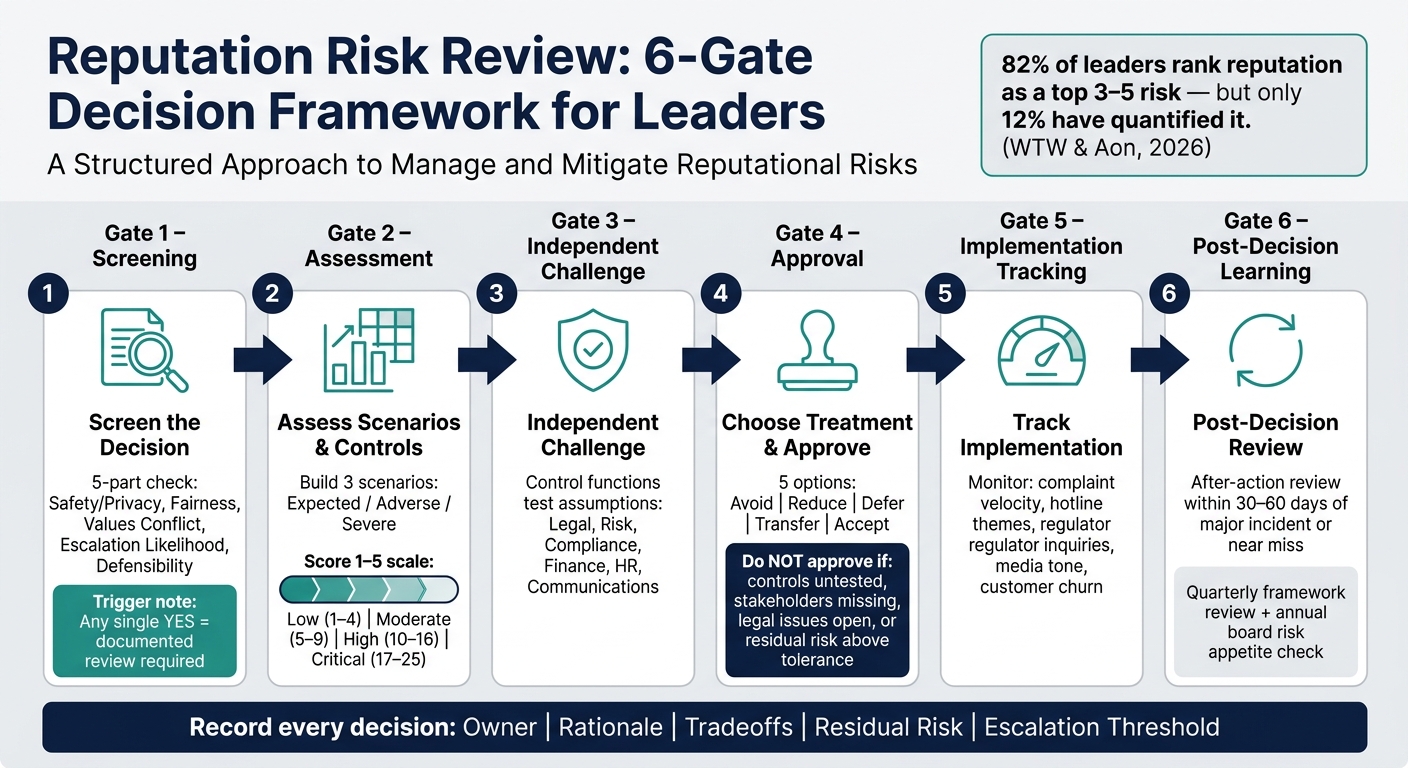
Reputation Risk Review: 6-Gate Decision Framework for Leaders
Once governance is set, leaders need one review process they can use for every major decision.
Screen the Decision and Map Stakeholders
Start with a five-part screen. The decision sponsor should check whether the proposal involves:
- Safety, privacy, or rights impact – health, product quality, data, AI, or surveillance
- Fairness or vulnerable-group impact – children, low-income communities, patients, or people with disabilities
- Conflict with values or commitments – stated corporate values or public commitments
- Likelihood of external escalation or regulatory scrutiny – litigation, boycotts, regulatory inquiries, or social-media escalation
- Defensibility – whether the decision can be explained clearly and defended publicly
A single yes should trigger a documented review. If a decision touches safety, privacy, vulnerable groups, or a material conflict with company values, it needs an enhanced review even if the financial exposure seems small.
After that, map stakeholders before judging the decision itself. That step matters because stakeholder reaction affects revenue, retention, funding, and approvals, not just public image.
| Stakeholder group | Exposure | Engagement owner |
|---|---|---|
| Customers and users | High – safety, privacy, reliability, fair treatment | Customer or product leader |
| Employees and contractors | High – fairness, transparency, job security | CHRO or business-unit leader |
| Investors and lenders | Medium to high – governance, resilience, accurate disclosure | CFO, investor relations, corporate secretary |
| Regulators and government agencies | Variable – compliance, cooperation, public protection | General counsel or compliance officer |
| Local communities and advocacy groups | High – safety, environmental responsibility, consultation | Public affairs or community-relations lead |
| Suppliers and partners | Medium – predictability, ethical conduct, continuity | Procurement or operations leader |
| Public narrative amplifiers | Low to high – speed, evidence, accountability | Communications lead |
Focus first on stakeholders with high influence and high exposure. Then look closely at groups where harm could spread fast or expose a gap between what the company says and what it does. That map shows which groups need the hardest testing in scenario analysis.
Assess Scenarios, Controls, and Business Consequences
Before scoring anything, define the decision in plain terms: what is being proposed, why now, who will be affected, what other options exist, and which assumptions support the proposal. Keep known facts, assumptions, and unknowns separate.
Then build three scenarios:
- an expected case where controls work as planned
- a credible adverse case where a control fails or a stakeholder group pushes back
- a severe but plausible case where several failures happen at once and regulators, investors, employees, and customers all react at the same time
Each scenario should show how loss of trust turns into churn, delay, cost, or pressure on valuation.
Score likelihood and consequence on a 1-to-5 scale. A total of 1–4 is low, 5–9 is moderate, 10–16 is high, and 17–25 is critical. Treat critical ratings as board-level issues, even when the dollar amount looks small.
Score controls based on proof, not policy. In other words, a control should count only if it is tested and clearly owned.
Next, map the path from decision to harm to stakeholder reaction to business impact. That chain makes it clear where prevention, detection, and response controls should sit.
Once the likely reactions are on the table, pick the treatment with the least risk that still protects the business case.
Choose a Response, Record the Rationale, and Apply Decision Gates
After the assessment, the sponsor chooses a treatment:
- Avoid – cancel or redesign when harm cannot be controlled
- Reduce – add safeguards, phase the rollout, or strengthen monitoring
- Defer – wait for missing facts, guidance, or completed testing
- Transfer – use insurance or contracts to assign financial exposure
- Accept – proceed within approved tolerance when residual risk is understood and explicitly approved
Every treatment plan should include an action, an owner, a deadline, and a residual-risk rating.
The record should show why the decision can be defended, which tradeoffs were accepted, and what will be monitored. Capture the decision, options, stakeholders, scenarios, scores, controls, dissent, conditions, communications, and approval rationale.
The process then moves through six standard gates: screening, assessment, independent challenge, approval, implementation tracking, and post-decision learning. Do not approve the decision if controls are untested, stakeholders are missing, legal issues are still open, or residual risk is above tolerance.
Capture the decision record right away. It becomes the base for crisis response, investor messaging, and employee communication.
sbb-itb-2fdc177
Connect Reputation Risk to Crisis Readiness, Investors, and Employee Trust
Once a decision is approved, the work shifts from review to follow-through. Use the decision record to track crisis signals, investor exposure, and employee impact as one connected system, not three separate checklists.
Connect Strategic Decisions to Crisis Scenarios and Early Warning Signals
Keep a live inventory of reputation-risk events, from cyber incidents to safety failures and missed commitments. This is the after-approval version of the scenario work already done during assessment.
Say you’re outsourcing customer support to cut costs. The approval record should spell out the data privacy, service quality, worker-treatment, and complaint-handling risks that come with that move. It should also list the controls, contract terms, and crisis response owner tied to each risk.
Early warning signals help you spot trouble before it spreads. Useful signs include rising customer complaint volumes, repeated control exceptions, audit findings, hotline reports, supplier violations, missed inspections, labor disputes, employee-retaliation allegations, lower participation in speak-up channels, negative shifts in sentiment, and unusual media attention. Apply the same owner-and-threshold discipline here too. A severe safety event should trigger immediate escalation. A gradual rise in complaints should trigger escalation after a set percentage increase or repeated breaches.
Run tabletop exercises to test verification, authority, notification timing, evidence preservation, and message alignment. After each exercise, document the gaps – unclear approval rights, outdated contact lists, inconsistent materiality judgments, weak manager guidance, or missing data needed for investor disclosure – and assign corrective actions with deadlines. WTW’s 2024/25 reputational-risk readiness survey found that 87% of organizations have a formal team that trains together and responds to negative news events, but only 34% tie that capability to KPIs, up from 19% in 2023.
That same monitoring should also shape what investors need to know.
Review Decisions Through an Investor Lens
Investors look at major decisions as signals of governance, disclosure, and execution. When a decision becomes public, they want to know whether leadership understood the risk, managed it well, disclosed material information accurately and consistently, and can carry out the stated plan.
For U.S. public companies, cybersecurity decisions also bring disclosure duties under SEC rules on material incidents, risk management, strategy, governance, board oversight, and management’s role. So a cybersecurity transformation isn’t just an IT call. It’s also a governance and disclosure issue, and it belongs in the investor review process. The jump in reputational concern tied to cyber risk makes that plain: 65% of respondents in WTW’s 2024/25 survey ranked cyberattack among their top reputational-risk factors, compared with 24% in 2023.
Use this structure for common decision types.
| Decision issue | Possible investor concern | Evidence required | Disclosure implication | Accountable owner | Escalation path |
|---|---|---|---|---|---|
| Major acquisition | Integration, culture, regulatory, or litigation risk | Due diligence, integration plan, scenario analysis, approval record | Assess material risks and consistency with guidance | CFO and general counsel | Investment committee, audit committee, board |
| Cybersecurity transformation | Exposure during transition and adequacy of oversight | Threat assessment, control roadmap, incident history, executive ownership | Consider Form 10-K governance disclosures and any material incident reporting | CISO and general counsel | CEO, audit committee, board |
| Workforce reduction | Execution, morale, legal, and retention risk | Workforce analysis, legal review, manager plan, critical-role assessment | Evaluate effects on guidance, operations, and stated values | CHRO and business-unit leader | CEO, board committee |
| Supplier change | Quality, labor, safety, and continuity exposure | Supplier diligence, audit results, contract controls, contingency plan | Assess material operational or compliance risks | Chief procurement officer | COO, compliance committee, board |
| Public sustainability commitment | Credibility and risk of missing a stated target | Baseline data, methodology, milestones, assurance, ownership | Align external claims with verified performance | Chief sustainability officer and CFO | CEO, general counsel, board |
Escalate when exposure could be material, hurt people, break a public commitment, or can’t be verified. The same applies when legal, finance, risk, and communications leaders don’t agree.
What investors read as governance, employees feel as fairness.
Protect Employee Trust When Decisions Affect Culture and Fairness
Employee trust shapes both reputation and day-to-day performance. PwC‘s U.S. Trust in Business Survey found that when employees don’t trust their employer, executives report clear business damage: 42% cited productivity loss, 41% cited product and service quality, 40% cited operational efficiency, and 38% cited profitability.
Before any decision that affects jobs, fairness, or culture goes live, leaders should test whether it lines up with stated values, whether similar employees will be treated the same way, and whether managers can explain the reasoning clearly. Legal compliance matters, but it isn’t enough. Employees also judge transparency, procedural fairness, and whether leaders hold themselves to the same standards.
Speak-up channels are a core control. Employees who believe they can speak up without retaliation are more likely to stay. Research cited by HubSpot indicates that employees who strongly agree they can speak up without fear of negative consequences are more likely to remain with their employer: approximately 95% versus 84% after one year, and approximately 89% versus 67% after two years. Low usage can be an early sign that risk is building out of sight.
The table below shows how investor and employee trust needs differ, and why both views belong in the same decision record.
| Dimension | Investor trust needs | Employee trust needs | Evidence | Communication responsibility | Feedback mechanism |
|---|---|---|---|---|---|
| Governance | Clear oversight, accountability, controls, and reliable disclosure | Fair decisions, consistent standards, and leaders who accept accountability | Board materials, control testing, decision records, employee case data | Board, CEO, CFO, general counsel, CHRO | Investor questions, employee surveys, town halls |
| Strategy and execution | Credible assumptions, milestones, capital discipline, and delivery against guidance | Clarity about priorities, roles, workload, and job implications | Operating metrics, scenario plans, workforce plans | CEO, CFO, business leaders, managers | Earnings feedback, manager forums, pulse surveys |
| Risk and safety | Evidence that material risks are identified and controlled | Physical, psychological, and ethical safety in daily work | Incident data, audit results, hotline trends, corrective actions | Risk, compliance, operations, HR | Hotline, safety committees, confidential reporting |
| Fairness and culture | Protection against litigation, misconduct, and execution risk | Consistent treatment, inclusion, due process, and nonretaliation | Promotion, pay, turnover, investigation, and discipline data | CHRO, managers, compliance, CEO | Appeals, employee resource groups, surveys |
| Crisis response | Timely, accurate, legally compliant disclosure and recovery plan | Honest updates, practical support, and protection from blame or retaliation | Crisis logs, communication approvals, remediation results | Crisis team, communications, managers | Customer and investor feedback, employee listening channels |
Use one record to show both external and internal impact. A restructuring, for example, should show investor savings, execution risk, employee selection criteria, support, and workload impacts in one place.
Make Reputation Review Measurable and Repeatable
One good review doesn’t mean much if the next big call starts from zero.
The aim is simple: build a process that works the same way every time, no matter who owns the decision or which business unit is involved.
Create a Standard Decision Record and Monitoring Dashboard
Every material decision should lead to a one-page record with the same core fields each time. That record should include the decision owner, business unit, decision date, strategic objective, expected benefits, financial exposure, implementation timeline, and decision classification. It should also show which products, markets, locations, and operations are affected.
From there, the record needs to spell out the stakeholder groups involved and what they are likely to expect. It should include trigger questions on fairness, safety, privacy, legality, employee impact, customer impact, and alignment with stated values. Add the main risk scenarios, current controls, proposed mitigations, residual risk, and the person accountable for that residual risk. Then document required approvals, public, customer, and employee commitments with delivery dates, plus indicators, escalation thresholds, crisis-plan links, and communication owners.
Just as important, the record should capture the why behind the decision: the rationale, rejected alternatives, assumptions, dissenting views, and next review date. In other words, it should preserve the tradeoffs, not just prove that someone signed off.
That record works best when it’s paired with a dashboard that tracks both process quality and risk signals.
On the process side, track:
- The share of material decisions screened before approval
- The number and severity of escalations
- Overdue mitigation actions
- Missed commitments
On the risk side, watch complaint velocity, employee hotline themes, regulator inquiries, media tone, social-media themes, and customer churn signals.
Each indicator needs three things: a named owner, a defined threshold, and a clear action tied to it. Keep the status labels easy to use: within appetite, approaching threshold, threshold breached, action overdue, and crisis escalation required.
Don’t squeeze all of this into one reputation score. A single combined number can hide the real issue: which stakeholder, decision, or control is driving the problem.
Review the Framework Quarterly and After Major Events
A quarterly review is a sensible baseline for most executive teams and boards.
Each review should answer five direct questions:
- Which indicators moved in a material way?
- Which assumptions changed?
- Which actions are late?
- Which risks keep showing up?
- Does the current risk appetite still fit the business environment?
The executive team should confirm owners and deadlines. The board, or the relevant committee, should push on a tougher point: does the framework still match strategy and risk appetite?
After a major incident or near miss, run a structured after-action review within 30 to 60 days once the immediate response has stabilized. That review should separate what was known at the time of the decision from what later turned out to be wrong. It should also ask whether warning signs existed but were missed, and whether escalation happened at the right level.
The review should also test a few plain but hard questions. Were the affected stakeholders identified correctly? Did communications match actual performance? Did controls fail in design, execution, ownership, or monitoring?
Near misses matter too. They deserve formal review because they can expose weak spots even when no loss occurs.
Each material finding should lead to a specific framework change, such as a new scenario, a revised escalation threshold, a different indicator, or an updated communication protocol. Zain Group offers a useful example. Its Board Risk Committee reviewed changing risk trends quarterly, approved framework changes annually, and checked risks against stated tolerances annually, with quarterly management and assurance checks.
Conclusion: Core Practices Every Leader Should Keep
Seven practices mark a mature reputation risk discipline. Treat reputation risk as an enterprise risk tied to strategy, operations, people, and finance, not as a communications issue handled after the damage is done. Map affected stakeholders for every material decision. Put one executive in charge while keeping independent challenge from control functions. Use approval gates linked to materiality and risk appetite. Document tradeoffs, conditions, and residual risk, not just the final call. Track leading indicators along with lagging outcomes and qualitative feedback. And test crisis links after incidents, near misses, and regulatory changes.
When done on a steady basis, this protects more than brand perception. It helps preserve customer and employee trust, investor confidence, regulatory flexibility, and management’s ability to carry out strategy when conditions change. A repeatable record-and-review system also gives boards hard evidence that reputation risk is being governed, not just talked about after a crisis is already underway.
FAQs
How do I start a reputation-risk review process quickly?
Define the scope, objectives, and stakeholders first. Then assign a skilled facilitator and set clear governance from the start.
Use a repeatable framework to:
- identify assets
- assess likelihood and impact
- build a mitigation plan
For fast visibility, set up online monitoring alerts and name a review team from communications, legal, and HR.
Document resources and reporting lines. Also, use 20 to 40 targeted questions to keep the first assessment efficient and actionable.
Which decisions need reputation review first?
Prioritize reputation review when decisions involve:
- new market entry
- complex or sensitive issues
- actions that could affect stakeholder trust
- localized communications before public release
- material developments that could trigger a crisis
Build these reviews into strategic planning early. That gives teams time to spot risks, address weak points, and deal with issues before they grow.
What metrics should leaders track after approval?
After approval, leaders need to watch the numbers that show whether the plan is working and who owns the outcome.
That usually starts with core financial metrics like cash burn, runway, budget variances, and KPIs linked to strategic goals, such as processing times or cost reduction. These figures help teams see, in plain terms, whether they’re moving in the right direction or drifting off course.
Leaders should also keep an eye on reputation and trust. That includes sentiment trends, Net Promoter Scores, customer lifetime value, engagement levels, plus response times and resolution rates. If financial metrics show what’s happening inside the business, these trust signals show how people on the outside are reacting.
Regular dashboard reviews make this easier. They keep performance visible, support transparency, and give leaders a clear way to spot issues early and adjust in time.