

I’d approve a sector carbon plan only when it has clear emissions rules, funded projects, and effective leaders as named owners. Before you commit, get a signed agreement covering what partners report, who pays, how disputes get settled, and when the board steps in.
My approval checklist comes down to four things:
- Agree on the numbers: Set reporting boundaries, share data and methods, and choose a baseline and targets. This ensures every strategic goal is measurable. Track total emissions – not just emissions per unit.
- Fund the work: Assign project owners, budgets in U.S. dollars, deadlines, and supplier duties. Keep emissions reporting separate from payment duties.
- Set the rules: Document accounting choices, data access, assurance, renewable-energy claims, and remedies for missed commitments.
- Track delivery: Link emissions, spending, and deadlines in one board dashboard. Set review triggers, such as delays over 90 days or cost overruns above 10%.
My bottom line: <u>put ownership, funding, and board oversight in writing before signing</u>.
Industrial Decarbonization as a Growth Strategy
sbb-itb-2fdc177
How Should Partners Set and Fund Joint Goals?
Once the inventory is set, turn it into a funded delivery plan with clear ownership. Translate the sector pathway into projects, while each company retains its own Scope 1, 2, and relevant Scope 3 duties.
Build on the boundary memo and approve the joint plan only through a charter. It should name the parties, scope, baseline year, methodology, target year, assumptions, funding, milestones, and accountable executives. Make this charter the decision record for goals, funding, and accountability – and the basis for targets and supplier commitments.
Which Baseline and Targets Should Partners Use?
Choose a baseline year from the same reported inventory, backed by reliable, comparable data. Record the methodology, target year, and milestones. Set rules for recalculating the baseline after major acquisitions, divestitures, methodology changes, or errors. Keep the original figures and explain any restatements. Then test whether the target holds up under a 12-month project delay or lower supplier participation.
Use absolute, intensity, renewable-power, supplier, and sector targets as needed. Track total emissions alongside intensity metrics: emissions per unit can fall while total emissions rise. State the intensity denominator and production assumptions.
Report carbon credits separately from inventory reductions. Include their quantity, standard, vintage, project type, and intended use.
Who Funds and Leads Each Reduction Project?
Give each project a lead partner, executive owner, budget in U.S. dollars, funding source, schedule, expected annual CO2e reduction, operating-cost impact, and dependencies.
Record decision rights in contracts, MOUs, transition plans, or joint-venture documents. Separate binding commitments from statements of intent. Allocate costs based on beneficiary share, emissions responsibility, influence, and commercial value, and document the reasoning.
Release funding in stages tied to feasibility, permits, procurement, and measured results. Monitor supplier delivery within the same plan.
What Must Suppliers Report and Deliver?
Set annual deadlines and milestones based on each supplier’s materiality and capacity. Use one template for baseline, target, activity, methodology, and progress data. Define access, retention, and confidentiality rules.
Give smaller suppliers training and calculation tools before escalating gaps through corrective-action plans or contract remedies. Measure the percentage of procurement spend or emissions covered, the share of supplier-specific data versus estimates, data quality, and target delivery.
When supplier-specific data is incomplete, use secondary data temporarily. Disclose the estimation method and set a timetable for replacing it.
How Should Agreements Address Carbon Plan Disputes?
Once the charter sets targets and funding, the agreement must explain how partners will handle disputes.
Set accounting, claims, and commercial rules before making any public commitment. Address boundary disputes, ownership, emissions factors, Scope 3 gaps, renewable claims, cost overruns, and missed milestones.
Should Partners Use Equity-Share or Control-Based Accounting?
Document each operation’s ownership, economic interest, control criteria, and reporting duties. Use the chosen method consistently. Contracts cannot override applicable accounting, securities, or climate-disclosure requirements.
Overlapping inventories aren’t necessarily errors. When reporting boundaries differ, the same emissions can appear in different companies’ scopes.
| Issue | Equity-share accounting | Control-based accounting |
|---|---|---|
| Basis | Economic interest, which may differ from legal ownership | Selected financial- or operational-control criterion |
| Included emissions | Share matching the company’s economic interest | 100% from controlled operations |
| Non-controlling investment | Included according to economic interest | Not reported under the selected control approach |
| Agreement must specify | Economic-interest percentages and supporting evidence | Control test, decision rights, and supporting evidence |
How Should Partners Resolve Data and Claims Conflicts?
Require data owners to exchange evidence within 10 business days. If the dispute remains unresolved, require independent expert review within 20 business days.
The review should check applicable standards, boundaries, calculation logic, factor sources, and documented estimates. Escalate material disputes to the steering committee. Specify how long partners must retain evidence, who can access data, who handles assurance, and who approves corrections. Public reports must identify unresolved uncertainty and separate estimates from assured results.
Assign renewable energy certificate (REC) ownership and retirement rights before approving claims. Require retirement evidence, reporting-period and geographic checks, and approval of marketing language. Only one partner may claim each renewable attribute. Lower market-based Scope 2 emissions do not prove lower atmospheric emissions.
Who Pays for Cost Overruns and Delays?
Allocate overruns, incentives, and applicable carbon-price exposure based on decision control and economic benefit.
Separate permitting or force-majeure delays from avoidable failures. Set corrective-action deadlines, revised milestones, disclosure duties, dispute procedures, and enforceable remedies. Require formal approval for material scope or cost changes and board notification when appropriate.
Feed these rules into the board’s progress reviews, and route unresolved disputes through board reporting and escalation.
How Should Boards Track Partner Progress?
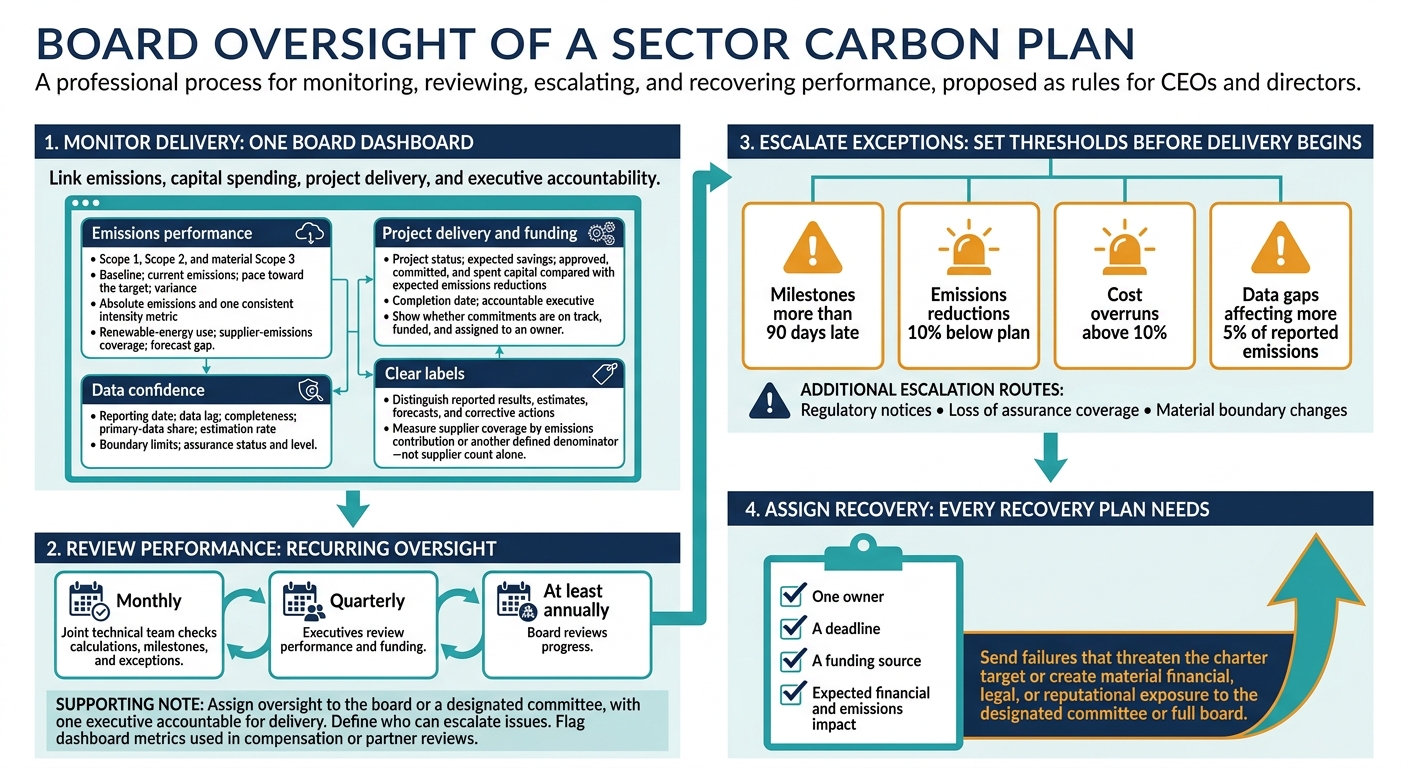
Sector Carbon Plans: Board Review and Escalation
Once dispute procedures and cost rules are set, the board needs a current view of delivery. Tie emissions performance to business decisions, not just annual reporting. Give directors one dashboard linking emissions, capital spending, project delivery, and executive accountability. It should show whether partner commitments are on track, funded, and assigned to an owner. IFRS S2 emphasizes governance, metrics, targets, and capital deployment.
What Should the Board Dashboard Show?
The dashboard should cover both results and execution. For Scope 1, Scope 2, and material Scope 3, show the baseline, current emissions, pace toward the target, and variance. Include absolute emissions and one consistent intensity metric, alongside renewable-energy use, supplier-emissions coverage, project status, expected savings, and the forecast gap.
For each charter-approved project, compare approved, committed, and spent capital against expected emissions reductions, the completion date, and the accountable executive.
Make data confidence visible. Show the reporting date, data lag, completeness, primary-data share, estimation rate, and boundary limits. Label reported results, estimates, forecasts, and corrective actions separately, and identify the assurance status and level. Measure supplier coverage by emissions contribution or another defined denominator – not supplier count alone.
Who Reviews Progress, and When Should Issues Escalate?
Set a clear review schedule and define who can escalate issues. Assign oversight to the board or a designated committee, with one effective leader accountable for delivery. A joint technical team should check calculations, milestones, and exceptions monthly. Executives should review performance and funding quarterly, and the board should review progress at least annually. Flag dashboard metrics used in compensation or partner reviews.
Set escalation thresholds before delivery begins:
- Milestones more than 90 days late
- Emissions reductions 10% below plan
- Cost overruns above 10%
- Data gaps affecting more than 5% of reported emissions
Also define escalation routes for regulatory notices, loss of assurance coverage, and material boundary changes. Require each recovery plan to name one owner, a deadline, a funding source, and the expected financial and emissions impact. Send failures that threaten the charter target or create material financial, legal, or reputational exposure to the designated committee or full board.
Conclusion: What Should CEOs Approve Before Committing?
After board review, CEOs should approve only what the partnership can measure, fund, and enforce.
Require a signed approval package – not just a joint pledge. Confirm that inventories are compatible, gaps are disclosed, and entity boundaries are clear to prevent double counting. Document the equity-share or control-based accounting method and use it consistently.
Approve the baseline year, target year, recalculation rules, and interim milestones. Each funded project should have a named owner, budget, timeline, funding shares, and rules for cost overruns.
The agreement should cover data rights, retention, confidentiality, and assurance terms. It should also set rules for claims, attribute ownership, and error correction, plus dispute procedures and remedies for nonperformance.
Before committing, obtain accounting, technical, assurance, procurement, tax, and legal review.
Make executive ownership, board reporting, and escalation conditions of approval – not details to settle after signing.