

Most CEOs wait too long to speak. That’s when trust slips, teams drift, and problems get harder to fix.
If I had to sum up the article in one line, it’s this: I should keep the facts the same, but change the message for each audience. The five groups here are boards, investors, employees, partners, and clients. Each group needs a different focus, a different tone, and the right timing.
Here’s the simple playbook:
- Board: lead with the decision, the risk, and what needs approval
- Investors: lead with results, proof, and what changed
- Employees: lead with priorities, context, and what to do now
- Partners: lead with shared goals, owners, and deadlines
- Clients: lead with impact, next steps, and who owns the fix
A few facts make the case clear:
- 82% of respondents in a Deloitte study said the CEO is responsible for trust leadership
- U.S. employee engagement fell to 30% in Q1 2024
- 29% of employees said effective leaders were not clear, honest, or consistent
- 63% of customers may switch after one bad experience
The article’s core framework is simple. Before I send any message, I should check six things:
- Who is this for?
- What do they need to decide or do?
- What proof backs this up?
- What tone fits?
- When should they hear it?
- Which channel should I use?
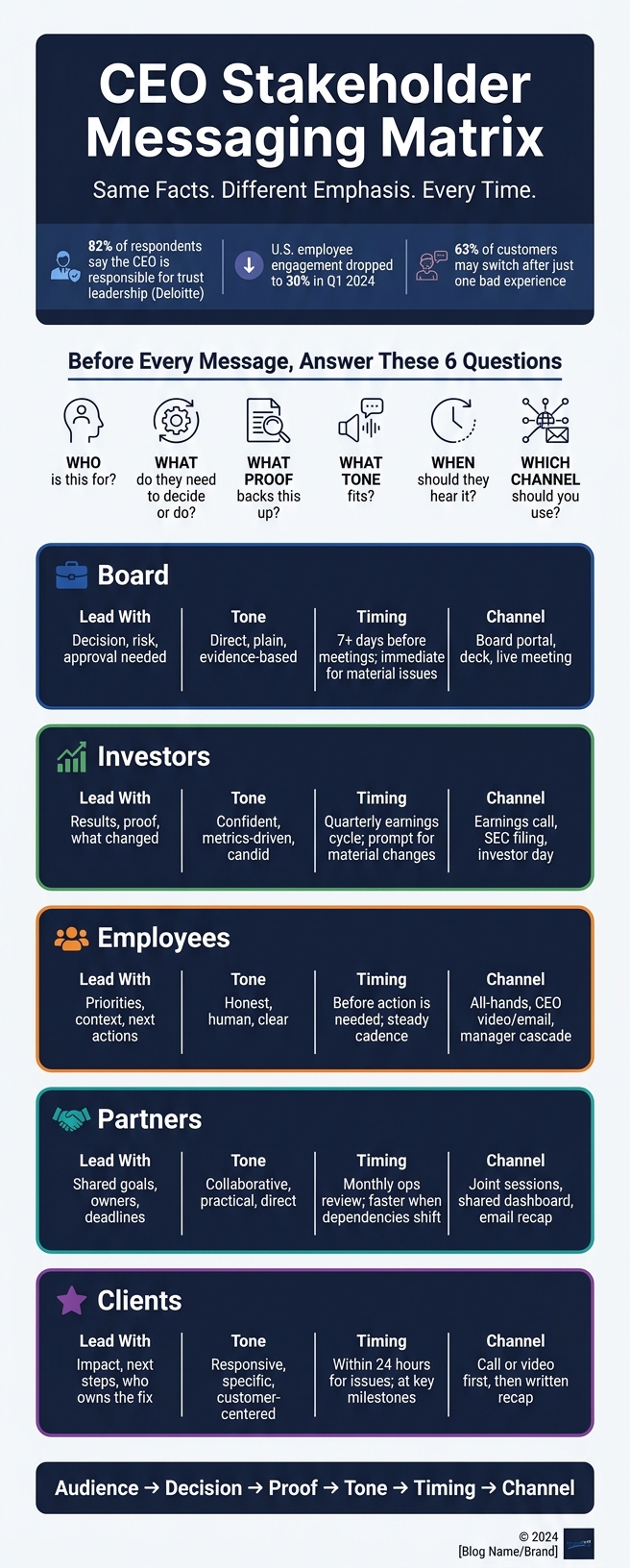
CEO Stakeholder Messaging Matrix: 5 Audiences, One Framework
How to Communicate and Influence Your Key Stakeholders
sbb-itb-2fdc177
Quick Comparison
| Stakeholder | Main need | Best tone | Best timing | Best channel |
|---|---|---|---|---|
| Board | Decision and risk view | Direct and plain | Before meetings; at once for material issues | Board deck, portal, live discussion |
| Investors | Proof that the plan is working | Clear and numbers-led | Quarterly; at once for material changes | Earnings release, filing, call |
| Employees | Direction and context | Honest and human | Before action is needed; steady updates | All-hands, email, video, manager follow-up |
| Partners | Shared ownership and next steps | Collaborative and plain | Set rhythm; faster if plans shift | Joint meetings, dashboards, recap email |
| Clients | Trust, impact, and recovery | Direct and customer-focused | Fast reply; update by a set time | Call or video, then written recap |
The big idea is simple: same facts, different emphasis. That’s how I keep messages clear, cut confusion, and help each group act on what matters now.
A Simple Framework for CEO Stakeholder Messaging
Before you draft anything, answer six basic questions: who is this for, what do they need to decide, what proof backs the message, what tone fits, when should they hear it, and which channel should you use? That simple check keeps CEO communication clear and useful. The five tactics below use this framework for boards, investors, employees, partners, and clients.
Define the Audience and the Decision They Need to Make
Start by naming the stakeholder, what they already know, what they still need, and the response the message should drive.
Different groups need different things. A board may need to approve a financing plan, requiring effective C-suite communication. A client may need reassurance that delivery is still on track. Those are not the same message, even if they come from the same CEO.
The more specific you are about the response you want – approval, alignment, feedback, patience, or execution – the easier it is to write something that gets that result.
Lead With the Outcome, Then Back It With Proof
Put the main point in the first paragraph. Then support it with evidence.
The proof should match the audience:
- Boards and investors look for financial data and risk data
- Teams and partners need operating results
- Clients care about service levels and delivery dates
Here’s the simple test: if the evidence would not hold up with Finance, Legal, or a customer, don’t send it.
Set the Right Tone and Level of Directness
Once the message is clear, match the tone to the audience.
Tone can shift depending on who’s reading it. The board may expect an analytical style. Employees may respond better to a purposeful tone. Partners may need a more collaborative approach. But the core style should stay the same: calm, credible, and accountable.
When the news is hard, say it plainly. Own the shortfall. A line like "We missed the target by 8%, and I own the decision that contributed to the shortfall. Here is what we are changing" builds more trust than softer wording that hides the issue.
"Accuracy and honesty build trust." – CEO Hangout
Choose the Right Cadence and Channel
Match the timing to the stakeholder’s decision cycle and to how fast the issue is moving.
Scheduled updates work well when the information is predictable, like monthly operating reviews, quarterly investor briefings, or weekly team priorities. But when something could affect trust, finances, or delivery, waiting for the next scheduled update is a mistake. In those cases, communicate right away.
| Scenario | Best channel | Cadence |
|---|---|---|
| Scheduled performance update | Written memo, board deck, investor briefing | Weekly, monthly, or quarterly |
| Active issue or risk | Verified alert, live briefing, direct email | As the facts change, with promised update times |
| Sensitive issue | One-on-one meeting, written recap | As needed, with documented follow-up |
Always close the loop. Say when the next update will come and who owns the next action.
Use this framework to tailor the five messages below.
Stakeholder Messaging at a Glance
The table below lays out the goal, tone, cadence, and channel for each stakeholder. Use it as a quick guide to fit the message to the audience.
| Stakeholder | Goal | Tone | Cadence | Channel |
|---|---|---|---|---|
| Board | Support decisions; flag material risk | Candid, concise, evidence-led | Quarterly formal updates; immediate for material risks or decisions | Board materials + live meeting or direct CEO-to-director discussion |
| Investors | Build confidence in strategy and execution | Consistent, transparent, metrics-driven | Earnings cycle plus prompt disclosure of material developments | Earnings call, shareholder letter, investor presentation, targeted calls |
| Employees | Translate strategy into priorities; reduce uncertainty | Clear, honest, motivating | Regular company-wide updates; more frequent during change | All-hands meeting, CEO email or video, manager cascade |
| Partners | Align on shared priorities, responsibilities, and milestones | Collaborative, practical, solution-oriented | Biweekly or monthly operating rhythm; faster when dependencies shift | Joint working session, shared project space, email recap, executive call |
| Clients | Demonstrate relevance, protect trust, and resolve concerns | Responsive, specific, customer-centered | Key milestones and service changes; within 24 hours when delivery is at risk | Account meeting, direct call, personalized email, or client portal |
Treat these as the default setting, not a hard rule. If there’s a product failure, acquisition, or financial shift, you may need same-day outreach to all five groups.
A simple way to pressure-test the table is to run one scenario through it. Take a delayed launch. The core facts don’t change, but the message does. The board needs a decision. Investors need guidance. Employees need priorities. Partners need updated dependencies. Clients need a delivery update.
McKinsey describes effective CEO stakeholder engagement as a yearlong process involving planned investor calls, customer visits, conferences, and other interactions rather than isolated communications.
The five tactics below show how to use this matrix with boards, investors, employees, partners, and clients.
1. Align the Board Around Decisions and Risk
Goal
For boards, every message should help move a decision forward. The board needs decisions, not status updates.
Start with the decision, the recommendation, the risks, and the next step. If you’re presenting a new-market proposal, spell out the investment, the upside, the downside, the regulatory risk, the mitigations, and the exact approval you’re asking for.
Tone
Be direct, transparent, evidence-based, and plainspoken. Separate facts from assumptions. Say what you know. Say what you don’t know.
Instead of saying a project is on track, be specific: the project remains within the approved budget, but adoption is 12% below plan; management recommends delaying the next hiring phase until two leading indicators improve.
Open and transparent CEO-board communication has been identified as a leading factor influencing organizational resilience in a 2025 survey of 739 board and C-suite leaders.
Be confident, but don’t gloss over uncertainty or bury bad news.
Timing
Send board materials at least seven days before a scheduled meeting so directors have time to review, question assumptions, and prepare useful discussion points. When a decision is major, preview it with the board chair or the relevant committee chair well before the formal meeting, especially if the issue is complex or sensitive.
Monthly or quarterly memos can track decisions made, risks changed, and actions due. But material developments shouldn’t sit and wait for the next meeting. Delayed disclosure and limited board visibility in the 2017 Equifax breach show why material risks must be escalated right away.
Channel
Use a secure board portal for pre-reads, dashboards, decision records, and anything that needs an auditable version history. Use live meetings for hard trade-offs and real-time debate. Use private one-on-one conversations with the board chair or lead independent director to surface concerns and get ahead of tough discussions, while making sure material information still reaches the full board in a consistent way.
Put a one-page summary first, then include the supporting data, scenarios, and milestones. Save technical detail for the appendix, not the main narrative.
Boards need decisions and clear risk framing; investors need proof those decisions are working.
2. Build Investor Confidence With Proof and Consistency
Goal
Once the board approves the plan, investors want proof that it can deliver. Every update should answer three basic questions: what changed, why it matters, and how progress will be measured.
Tie each major strategy claim to a clear metric. For example: "Automation cut processing time 18% in Q2; the next phase targets lower unit costs by year-end." If results fall short, don’t dance around it. State the gap, the cause, the fix, and the metric that will show recovery.
Tone
Be confident, candid, and precise, not promotional. Let the numbers do the heavy lifting.
Consistency matters just as much as the message itself. Use one message map, and have it reviewed by the CEO, CFO, legal, and IR before any release.
Timing
Stick to a fixed quarterly cadence: earnings release, SEC filing, prepared remarks, earnings call, then follow-up Q&A.
Material information should be shared broadly before the call or right as it starts, never for the first time in a private conversation with one analyst. If guidance or major assumptions change between scheduled updates, communicate promptly. Waiting until the next earnings call can make a fixable problem look like something was being kept under wraps.
Channel
Use the earnings release and SEC filing as the official record. Use the earnings call for context and Q&A. Use investor days for multi-year strategy and capital allocation. And keep one-on-ones limited to information that is already public.
Regulation FD prohibits selective disclosure of material nonpublic information to any subset of investors. Social posts should match the official filing or release. The same message map should carry across public updates so investor communication lines up with what employees and partners are hearing too.
3. Give Employees Direction and Meaning
Goal
Employees need to know what matters now, why it matters, and what they should do next. That’s the CEO’s job: turn company strategy into clear priorities teams can use today. And once those priorities are set, the message has to sound like it came from a person, not a press office.
Research on CEO vision communication found that communicating a credible and achievable organizational vision gives employees a stronger sense of purpose and connection, which in turn supports engagement. That matters right now. U.S. employee engagement fell to 30% in Q1 2024, and 29% of employees said leaders lacked clear, honest, or consistent communication.
Tone
Be direct, honest, and human. People can spot the gap between a plainspoken update and a polished press release in seconds. If something is uncertain, say that. If a decision is hard, say that too, then walk people through the reasoning.
Skip optimism that isn’t backed up. Skip praise that doesn’t mean much. When goals aren’t met, explain what the team was trying to do, what got in the way, and what happens next.
This also needs to be a two-way conversation. Tie each update back to purpose, and do it in the language employees already use, not vague corporate wording.
Timing
Say it before employees have to act or start filling in the blanks on their own. That includes communication ahead of restructuring or strategy shifts, not after confusion has already spread. For priorities that stretch over time, a steady cadence helps keep teams on track. Quarterly updates and milestone check-ins can keep alignment from slipping.
Because effective managers drive most team engagement, the CEO’s message should also give managers what they need to repeat it clearly in team discussions. Brief them before the company-wide announcement goes out.
Channel
Once timing is set, channel choice shapes whether employees actually hear the message and trust it. Use productive all-hands meetings or live video for strategy shifts that call for visible leadership and live questions. Use written memos for decisions people need to look back on or forward to others. If a change affects people in a direct way, handle it in small-group or one-on-one conversations, not as a line buried in a company-wide email.
A simple mix often works best:
- CEO message
- Written recap
- Manager cascade
- Feedback path
Use video when people need to see leadership and ask questions in real time. Then back it up in writing so the message doesn’t get lost.
4. Strengthen Partner Relationships Through Shared Priorities
Partner messaging should lock in execution, ownership, and escalation before work starts.
Goal
Partner communication should align both sides on shared priorities, decision rights, success measures, and non-negotiables. Start with the joint objective: what both organizations are trying to achieve together. Then make success clear to both teams.
Set non-negotiables upfront, including customer experience, data security, compliance, and brand standards. That way, alignment doesn’t rest on guesswork. Partner messages should drive execution, not just keep the relationship warm. Every joint milestone should tie back to a customer outcome or business commitment.
A simple structure helps: We will achieve [shared outcome] by [date] by contributing [resources] on our side and [resources] on yours, measured by [metrics]. This cuts ambiguity and gives both operating teams a plain reference point. In a 2025 survey of executives, alignment of partnership objectives was the top success factor cited by 47% of respondents, followed by effective internal communication and trust at 44%.
That level of clarity also makes it easier for both sides to speak plainly when the plan shifts.
Tone
Use a candid, collaborative, respectful tone, and be clear about terms and commitments. Treat the work like a joint effort, not a vendor arrangement or a tug-of-war over control.
Be direct about risks, delays, and constraints, but frame them as shared problems to solve. Instead of pointing fingers, say: The launch is two weeks late because integration testing is incomplete. We need both teams to confirm a revised plan by Friday, with owners, dependencies, and customer-impact fixes.
Avoid language that puts only your company at the center. A phrase like co-owned milestone signals that the relationship is mutual.
Timing
At kickoff, agree on review dates, escalation triggers, and response times. One practical setup looks like this:
- A monthly operating review for KPIs and blockers
- A quarterly executive review for strategic direction
- An immediate escalation path for anything that could affect customers, security, legal obligations, material costs, or public commitments
If a product delay, budget change, or leadership transition could affect the partner, tell them before the impact becomes unavoidable.
That same rhythm should also define who gets updates live and who gets them in writing.
Channel
Use executive video calls or in-person sessions for strategy, tradeoffs, and relationship repair. Use shared dashboards and written recaps for metrics, action items, and accountability. After any live discussion, send a short written record that covers decisions, owners, deadlines, and the next review date. This keeps both sides working from the same facts instead of separate recollections.
| Message type | Best channel | Key strength |
|---|---|---|
| Strategic direction or conflict | Executive video or in-person meeting | Supports candid discussion and nuance |
| Progress updates and KPI reviews | Shared dashboard plus written recap | Creates a common source of truth |
| Urgent risk or missed commitment | Immediate call, then documented recap | Limits surprises and speeds response |
| CEO networking | Periodic in-person or informal sessions | Strengthens trust beyond formal reviews |
5. Earn Client Trust With Relevance and Responsiveness
Client messages fall flat when they sound generic instead of speaking to the client’s actual problem. That gap can cost you. 63% of customers are willing to switch to a competitor after one bad experience. Partners may look for shared priorities. Clients want to see follow-through.
Goal
Every message should connect to the client’s business outcome: lower risk, better efficiency, launch timing, or issue recovery. Then make the next part simple: state the action, show the proof, and spell out what happens next.
Example: Your distribution expansion depends on reliable fulfillment across three regions. We added capacity in our two highest-volume facilities, cut processing time 18%, and will review results with your team on Oct. 15.
The message should also match the stage of the relationship. A renewal-stage client wants proof of ROI. A new client wants a clear picture of implementation. A dissatisfied client does not want a routine status update. They need acknowledgment, ownership, and a recovery plan. That kind of clarity matters even more when the news is bad.
Tone
Use plain, direct language. Skip vague apologies. Skip language that sounds like you’re trying to protect yourself. If something went wrong, say what happened, explain the impact without downplaying it, name the fix, and make clear who owns it.
"The outage interrupted your customer-support operations for 47 minutes. We own the failure, restored service, and will share the root cause and prevention plan by Friday."
In a crisis, separate three things clearly: what is known, what is still under review, and when the client will hear from you next. That kind of structure does more to calm uncertainty than a polished but fuzzy statement.
Timing
Acknowledge client issues fast, then treat acknowledgment and resolution as two different steps. Give the client a clear owner and a specific time for the next update. A fast note like We have your request, we are investigating it, and we will update you by 3 p.m. ET today feels far more trustworthy than silence or a promise with nothing behind it.
The CEO should step in for high-stakes client moments and make sure each major issue has a named owner. That visibility matters most during:
- Onboarding
- Major milestones
- Renewals
- Material service changes
- Executive escalations
- Post-incident reviews
Once timing is handled, the next question is simple: are you using the right channel for the level of risk?
Channel
| Situation | Best channel | Key goal |
|---|---|---|
| Service incident or major escalation | Phone or video, then written recap | Restore confidence and assign ownership |
| Contract or pricing change | Executive email plus call | Preserve trust and explain value |
| Major milestone update | Video or phone, followed by email | Confirm progress and align next steps |
| Complex strategic decision | Video or phone, followed by email | Clarify implications and options |
A smart approach is to combine channels. Acknowledge the issue fast in the client’s preferred channel. Talk through messy or high-stakes details live. Then send a short written recap with owners, deadlines, and the next update. That way, account, support, and operations stay on the same page – and the client doesn’t get mixed messages.
Messaging Mistakes CEOs Should Avoid
Small slips in structure, timing, or channel can chip away at trust fast. Before sending any major stakeholder message, run it through these six checks. These are the mistakes most likely to weaken your board, investor, employee, partner, and client communication.
Too Much Detail, Not Enough Signal
Start with the point. Then trim the rest.
Lead with the takeaway, spell out the decision or action, and back it up with two or three facts. Save the extra detail for an appendix. If people have to dig through a wall of context to figure out what matters, the message loses force.
Delaying Bad News Weakens Trust
Silence gives people room to fill in the blanks, and they usually don’t fill them in kindly.
A timely update doesn’t have to answer everything. It does need to separate what is known, what is uncertain, what has changed, and what happens next. Research suggests that stakeholders may react negatively in the moment but later view candid communication more favorably because it signals honesty. Say something early, then follow up with the next update as facts come in.
Inconsistent Narratives Create Confusion
Adjusting the emphasis for each audience makes sense. Telling different versions of the same story does not.
If a restructuring is framed as "cost reduction" for investors but "growth investment" for employees, those groups will compare notes sooner or later. And when they do, trust takes a hit. A better move is to stick to one core message:
- one business reality
- three supporting facts
- one priority
Then tailor the implication for each audience, not the facts underneath it. Consistency between what leaders say and what they do is closely tied to trust and commitment, and consistent follow-through strengthens confidence in leadership qualities.
One-Way Updates Miss Feedback Signals
An announcement isn’t a conversation.
If the message matters, build in a way for people to respond. That could be a live Q&A, an anonymous channel, or a manager feedback loop. Then close the loop and share what changed because of that feedback. Otherwise, you’re talking at people when you should be listening too.
The Wrong Channel Can Make a Hard Message Worse
With sensitive news, format often matters more than speed.
Layoffs, a missed financing milestone, or a major client failure should get a live first response. Email can come after as the written record. Sending hard news by email just because it’s easier can read like avoidance. Match the channel to the stakes: the more emotional weight or complexity a message carries, the more it needs a real-time, two-way format before anything goes in writing.
Promises Without Proof or Ownership Backfire
Saying you’re improving customer response times is just a promise. An accountable commitment is much tighter.
It names the outcome, the owner, the resources, the timeline, and the reporting cadence – for example, reducing median response time from 18 hours to 8 hours by December 1, with two additional support teams and weekly reporting. That gives people something concrete to judge.
Vague commitments, especially repeated ones, teach stakeholders to tune you out. If conditions are uncertain, say so plainly. Name the assumptions and dependencies instead of making guarantees you can’t support. In practice, that means every major commitment should include:
- the outcome
- the owner
- the timeline
- the resources
- the reporting cadence
Conclusion
Boards, investors, employees, partners, and clients each need a different message. But the discipline behind those messages stays the same. Ask a simple set of questions: What does this audience need to understand? What do they need to decide? And what should they do next? That same approach runs through the five tactics above and helps keep every message clear, honest, steady, and carried through.
Trust grows through repeated communication that fits the audience and connects the company’s actions to each stakeholder’s top concerns. McKinsey describes the CEO as the organization’s "storyteller-in-chief", responsible for setting tone, purpose, and action in critical moments. And that job doesn’t stop once the announcement is made. It carries on through follow-through, feedback, and visible accountability.
Use the same test every time: audience, decision, proof, tone, timing, channel.
FAQs
How do I keep one message consistent across all stakeholders?
Pick one core message: a short, plain sentence tied to a business goal like growth or efficiency. Then use that message as the filter for every piece of communication.
The message itself should stay the same. What changes is how you deliver it. For employees, lean into culture and shared direction. For investors, focus on metrics and business results. For customers, stress the problems you solve. A framework like PREP can help keep each version clear and focused.
When should a CEO communicate immediately instead of waiting?
A CEO should speak up right away during a crisis or any market-moving event. Early communication cuts down uncertainty, slows rumors, and helps keep stakeholder trust intact.
This also matters when false claims start spreading in the media or on social platforms. In major events or periods of market volatility, a good rule is to issue an initial statement within 2 hours, then follow with more detailed updates within 24 hours.
What is the best channel for sensitive stakeholder updates?
Use secure, dedicated platforms for sensitive stakeholder updates. For board members, that usually means secure board portals and encrypted messaging for confidential documents and quick updates.
In crises or other high-stakes situations, put internal channels first. Video messages, for example, can help your team hear the news from you before it reaches the outside world.