

Most CEO stories fail for one simple reason: they don’t lead people to a clear decision.
If I want a CEO story to work in productive meetings, all-hands, investor update, or media remark, I need to build it around five parts: audience goal, one main message, one point of tension, proof, and a clear close. That means I start with what the audience should believe and do, show the gap between the current state and the target state, back it up with numbers like 18.5% churn or $3.2 million in ARR at risk, and end with one action and one deadline.
Here’s the whole process in plain English:
- Start with the audience goal: What should people think and do after the story?
- Boil it down to one message: One sentence people will remember.
- Add tension: Show the problem with facts, costs, and timing.
- Use proof: Support the story with metrics, examples, and results.
- Close with action: One lesson, one next step, and one deadline.
If I’m telling a story about a $50 million expansion, I won’t frame it the same way for a board and for employees. The board wants the decision case and downside risk. Employees want to know what changes for their jobs and teams. Same story topic. Different angle.
A simple way to pressure-test the story is this line: After this story, the audience should believe X and do Y. If a detail doesn’t help me get there, I cut it.
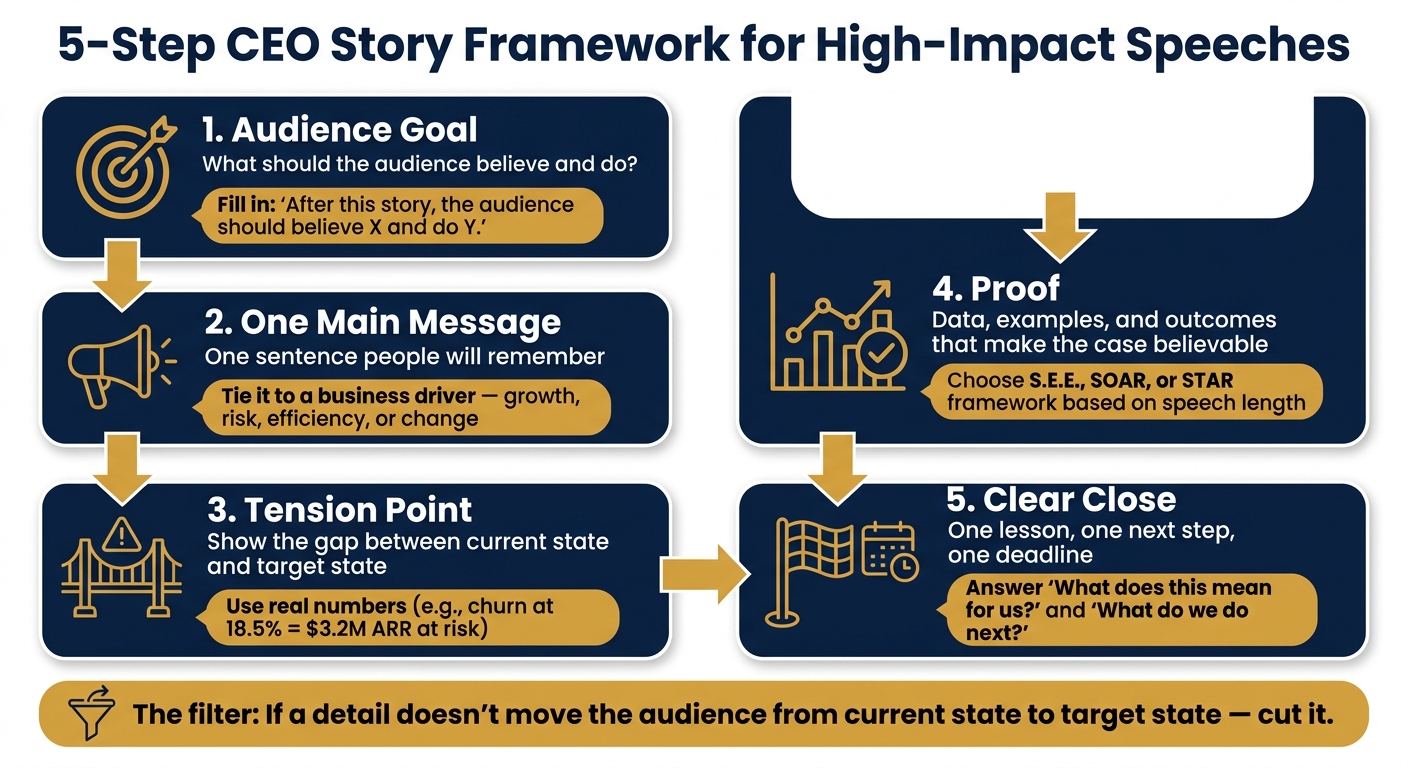
5-Step CEO Story Framework for High-Impact Speeches
The power of strategic narrative | Andy Raskin
sbb-itb-2fdc177
Quick Comparison
| Part | What I focus on | What it does |
|---|---|---|
| Audience goal | Belief + action | Keeps the story tied to the room |
| Main message | One sentence | Gives people one takeaway |
| Tension | Problem, cost, timing | Creates urgency |
| Proof | Data, examples, outcomes | Makes the case believable |
| Close | Lesson, action, deadline | Moves people to act |
That’s the full business storytelling framework: know the room, state the point, show the problem, prove it, and end with a direct ask.
Step 1: Define the Audience Goal Before Writing the Story
Before you draft anything, answer one question: What should this audience believe and do after hearing this? If you can’t answer that clearly, the story might be interesting but still miss the mark. That goal shapes the stakeholder lens you use.
Build the plan around five fields: audience, context, current state, target state, and target action. Who’s in the room? What’s the business context? What do they believe now? What should they believe after? And what exact decision or behavior should come next? Those inputs shape the opening and keep the story tied to the audience’s world, not just the CEO’s message.
Match the Story to the Audience’s Decision
Different stakeholders need different angles. The table below shows the main difference:
| Audience | What they care about most | Lead with |
|---|---|---|
| Employees | Job security, fairness, career growth | Why the change is happening, what support exists |
| Investors | Growth, ROI, competitive position | Market opportunity, metrics, timing, value creation |
| Board members | Governance, risk, strategic fit | Tradeoffs, capital allocation, decision rationale |
| Customers | Service quality, reliability, benefits | Trust, product impact, outcomes |
Once the audience lens is clear, boil the story down to one sentence tied to a decision.
A CEO presenting a $50 million U.S. manufacturing expansion to a board should lead with the capital-allocation case and downside risks. Tell that same story to employees, and the focus shifts. Now it’s about what the expansion means for their roles, their teams, and the company’s long-term stability.
Write the Audience Goal in One Sentence
Turn the plan into a single line: After this story, the audience should believe X and do Y. That sentence becomes the filter for every story choice.
For a reorganization of a U.S. regional sales team, the goal might be: After this story, sales reps should believe the new territory model is fair and will increase their earnings, and commit to working the new territories. For a new digital growth plan pitched to top U.S. customers: After this story, our top 50 U.S. customers should believe our new digital platform will make them more efficient, and agree to join the early adopter program. Put that sentence at the top of the speech draft. If a story element – an anecdote, a statistic, a slide – doesn’t help move the audience from current state to target state, cut it or rework it.
Next, build the story spine around one message and one tension point.
Step 2: Build the Story Spine with a Clear Message and Tension Point
Once the audience goal is clear, the next step is to shape the story itself. Use the goal from Step 1 to build a spine around one message, one tension point, and one outcome. Start with current reality, move to the risk or shift, and then lead into the next decision.
Choose One Key Message the Audience Will Remember
Boil the speech down to one sentence: The one thing this audience should remember is [message].
That message should be short, plain, and tied to a business driver such as growth, risk, efficiency, trust, or change leadership. Think of it as the line people should still remember after the meeting ends.
For example, if the goal is board buy-in for a new data platform, the key message might be: Investing in unified data is the fastest way for us to unlock profitable growth over the next three years.
Create Tension with a Specific Business Problem
Tension comes from the gap between where the company is today and where it needs to go next. But it has to feel concrete. Vague lines like performance is lagging don’t create urgency. Numbers do.
For example:
Our customer churn has climbed to 18.5%, up from 12% two years ago, which means we’re losing nearly $3.2 million in annual recurring revenue.
Or:
We’ve grown to 12,000 employees, but engagement scores have dropped 9 points in three years.
The pattern is simple:
- Show the trend
- Show the cost
- Show why it matters now
That’s what turns a fuzzy issue into a problem people can feel – and act on.
Compare Common Story Spines for CEO Speeches
Three story structures cover most CEO speeches. Each one works best for a different kind of moment.
| Story Spine | Best Use Case | Strengths | Limitations |
|---|---|---|---|
| Context-Tension-Resolution | Strategic narratives, town halls, investor days | Builds emotional and logical urgency; easy to follow; keeps focus on relevance and payoff | Can feel too broad if the tension isn’t grounded in specific numbers or decisions |
| Situation-Complication-Resolution | Board updates, decision memos, operational briefings | Matches how executives process problems; strong for justifying trade-offs and actions | Can feel dry if not connected to purpose; less engaging for broad internal audiences |
| Before-After-Bridge | Transformation stories, culture shifts, post-merger integration | Makes the future state clear; motivates behavior change; clarifies the journey with milestones | Can sound like wishful thinking if the bridge lacks credible proof or a concrete plan |
Here’s the shortcut:
- If the speech needs to build urgency around a priority, use Context-Tension-Resolution.
- If the speech needs to justify a specific decision, use Situation-Complication-Resolution.
- If the speech needs to help people see a longer change journey, use Before-After-Bridge.
Once the spine is in place, the next step is to add proof that makes the tension believable.
Step 3: Add Proof That Makes the Story Credible
Once the spine is in place, proof is what makes the story feel real. It has two jobs: show that the problem is real and show that the result can be believed.
Use Numbers, Examples, and Outcomes at the Right Moment
Put proof in two places: when the tension becomes measurable, and when the result is impossible to miss.
In the tension section, a small cluster of metrics can turn a fuzzy concern into a clear business risk. For example, customer churn at 14% puts $9.2 million in annual recurring revenue at risk – specific, tied to time, and easy to compare. Now the audience has something they can track, not just react to.
Then show the turnaround in the same terms the audience uses to judge success. Within 18 months, we reduced cost of goods sold from 61% to 55% of revenue, cut inventory write-offs by $2.8 million per year, and improved on-time delivery from 89% to 97%. Those numbers finish the arc without making the speech read like a finance deck.
To keep the story moving, add a short bridge before each proof cluster – something like Here’s what that looked like in the numbers – so the shift from story to evidence feels smooth.
Choose a Proof Structure That Fits the Speech
You can use one of three proof frameworks: S.E.E., SOAR, or STAR. Each one helps you work evidence into the story without snapping the thread.
S.E.E. (Situation–Evidence–Effect) works best for short remarks – investor Q&A, media interviews, or quick town hall updates. These moments are critical for ceo networking and building long-term influence. It gets to the point fast.
SOAR (Situation–Obstacles–Actions–Results) fits longer narratives like annual strategy updates or board presentations, where people need to see how the team dealt with real barriers.
STAR (Situation–Task–Action–Result) is a good fit for leadership stories and internal town halls, especially when the audience wants to understand how the CEO and team handled a specific challenge and what came out of it.
Compare Proof Frameworks for CEO Stories
| Framework | Typical CEO Use | Strengths | Limitations |
|---|---|---|---|
| S.E.E. (Situation–Evidence–Effect) | Short remarks, investor Q&A, media interviews, brief updates | Concise; direct link between situation, evidence, and effect; strong for one key decision with clear USD metrics | Thin on obstacles and actions; can feel surface-level for complex transformations |
| SOAR (Situation–Obstacles–Actions–Results) | Strategy updates, board meetings, transformation narratives, detailed investor days | Full arc from problem to barriers to results; fits multiple proof types; demonstrates execution rigor | Takes more time; each step needs focus to avoid data overload |
| STAR (Situation–Task–Action–Result) | Leadership stories, internal town halls, performance reviews, talent development | Clear on goals and decision-making; relatable for specific challenges; effective when Result is tightly quantified | Task step can feel redundant in strategic narratives; may underplay systemic obstacles |
Pick the framework that best fits the lesson you want to land and the action you want people to take next. When the proof is clear, you can move into the lesson, the action, and the habit you want people to repeat.
Step 4: Close with a Lesson, Action, and Repeatable Habit
Once the proof lands, close with the decision, habit, and deadline.
A strong close should settle the tension, restate the main message, and spell out the next move. It should NOT bring in new information.
Turn the Ending into a Decision or Behavior Change
The best CEO closings answer the two questions everyone in the room is already thinking:
- What does this mean for us right now?
- What should we do differently after today?
If your ending doesn’t answer both, you don’t have a close yet. You have a summary.
A simple way to shape the ending is to move from what this means for us, to what we will do, to the habit we will repeat. Say the tension in a strategy speech was a lack of focus that dropped operating margin by 1.8 percentage points last year. The close could say:
The lesson is simple: focus spending on growth. By Nov. 1, exit non-core markets and align budgets to the three strategic bets. Next Monday, bring one project to stop.
That works because it resolves the tension, repeats the message, and turns the message into a clear habit with a deadline.
Keep the lesson to one sentence. Then turn it into one repeatable habit and connect it to a metric or routine the audience already knows. For U.S. executive teams, habits tied to routines already on the calendar – Monday standups, quarterly business reviews, sprint retrospectives – are more likely to stick because people can put the message to work right away.
A common miss is ending with a loose call instead of a direct request tied to a deadline and a measurable result. Keep the close between 100 and 200 words. Stick to one lesson and one action. On the last sentence, pause and hold eye contact.
Use CEO Hangout to Test and Improve Speech Stories
If you want outside feedback, test your closing line with peers in CEO Hangout before board presentations, earnings calls, or town halls.
Conclusion: A Simple Process for Building Stronger CEO Stories
Strong CEO stories tend to follow the same five-part structure: audience goal, key message, tension, proof, and action. Use that framework in board meetings, town halls, and investor updates to keep the story on track from beginning to end.
Build the story around the audience, not around the part that seems most interesting to tell. When the story starts with what the audience needs to decide or do, the rest gets much easier to shape.
Before any major speech, run a quick check on five points: audience goal, one message, specific tension, proof tied to the message, and a clear next step. If those five pieces are clear, the story is ready.
FAQs
How do I tailor the same CEO story for different audiences?
Identify what each audience cares about first. Then adjust the angle of the story to fit that interest.
The main message stays the same. What changes is the emphasis.
- Employees: focus on culture and growth
- Investors: focus on metrics and returns
- Customers: focus on solutions
- Partners: focus on collaboration
What kind of proof makes a CEO story more credible?
The strongest proof comes from hard data tied to lived experience. Show results people can check for themselves: metrics, progress over time, benchmarks, or clear numbers that point to impact. When you can connect an action to an outcome, the story feels grounded instead of hand-wavy.
At the same time, don’t lean on facts alone. Weave the numbers into the emotional part of the story, especially in the middle and close to the key moment or lesson. That way, people don’t just believe the claim – they also feel why the takeaway matters.
How do I know if my story leads to a clear action?
Tie your story to a clear goal. It shouldn’t feel like a random anecdote dropped into the page. It needs to support a specific point and move the reader toward it.
A simple way to do that is to make sure the story includes three parts:
- the challenge
- the action you took
- the outcome
That structure keeps the story grounded. It also helps the reader see why the story matters, not just what happened.
Stay focused on the details that support your main message. If a detail doesn’t help explain the problem, the response, or the result, cut it. Extra background can water down the point.
End with a takeaway that connects back to your organization’s goals. Show the reader what the story means and what they should do with it. That final step turns the story from something interesting into something useful.