

If I run a mid-market company, I’d judge any CEO network on the benefits of business networking and four specific things: peer fit, global reach, access model, and referral quality.
In plain terms, I want to know:
- Will I meet CEOs at my size? The article points to the $5 million to $100 million+ range as a core benchmark.
- Is the group screened? Formal applications, fixed intake periods, and attendance rules often mean a better room.
- Does it have cross-border reach that I can use? A network may have a big roster, but I’d care more about where members do business and whether they can help in those markets.
- Can I take part without losing too much time? The mix matters: online channels for fast answers, regional meetups for local ties, and annual retreats for deeper trust.
- Do introductions come with context? A no-pitch rule, confidentiality standards, and care around direct competitors help keep the group useful.
The main idea is simple: the best network is not the one with the biggest name or the most members. It’s the one that puts me with senior peers facing the same level of company demands, with access to the regions I care about, in a format I’ll use.
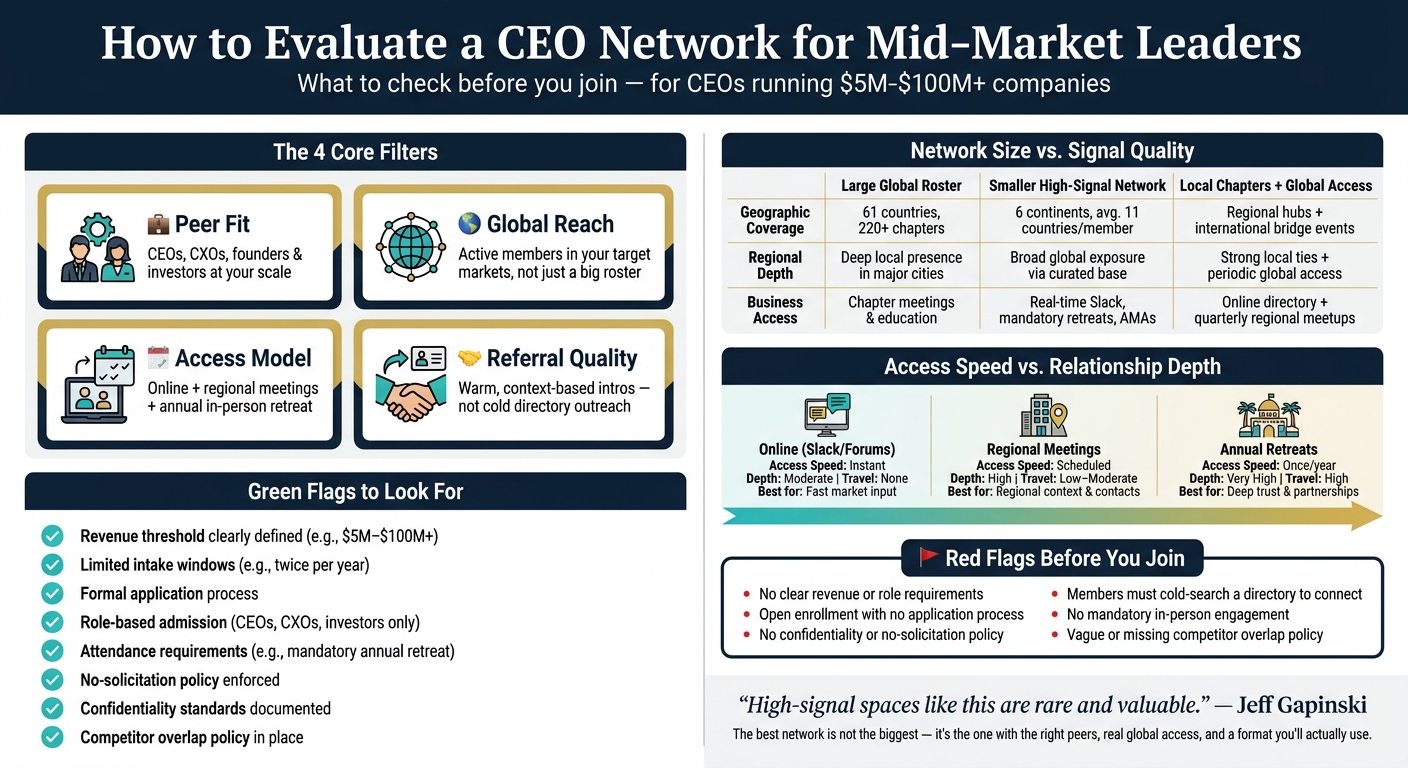
Mid-Market CEO Network Evaluation Framework: Key Criteria at a Glance
Lessons in Leadership (feat. CEO Global Network Founder, John Wilson) | Brews & Buzzwords Podcast
sbb-itb-2fdc177
Quick Comparison
| What I’d Check | What I’d Want to See | Why It Matters |
|---|---|---|
| Peer fit | CEOs, CXOs, founders, and investors at similar scale | Better conversations, fewer mismatched problems |
| Company size | Clear range like $5 million to $100 million+ | Keeps discussion aligned with mid-market issues |
| Screening | Application process, limited intake, attendance rules | Helps keep the room serious |
| Global reach | Active members in target markets, not just a big list | More useful for market entry and cross-border work |
| Access model | Online + regional meetings + annual in-person time | Gives both fast contact and stronger ties |
| Trust rules | Confidentiality, no-solicitation, competitor handling | Makes people more willing to share |
| Referral quality | Warm, context-based introductions | Better than cold directory outreach |
For me, that’s the filter: same-level peers, active global access, clear rules, and a format that fits my calendar and time management needs.
What Should Mid-Market CEOs Check First?
Before you look at a network’s brand name or total member count, check the peer fit first. That’s the part that changes everything.
A community packed with solopreneurs, freelancers, or people hunting for basic startup advice won’t give a mid-market CEO the kind of room they need. The title might sound close on paper. The day-to-day reality usually isn’t.
Check Executive Level, Company Scale, and Screening Standards
Start with a simple question: does the network limit access to actual CEOs, CXOs, founders, investors, and other C-level leaders, or can almost anyone join as long as they pay?
You also want to see clear revenue thresholds that line up with your company’s size. For example, CEO Hangout is built for B2B SMEs with revenue from $5 million to $100 million+, and it runs a moderated community of 175+ executives. That level of detail matters. It means members are more likely to deal with the same kind of operational load, not just share a similar title.
Some networks only open membership twice a year and require a formal application process. That’s usually a good sign. It shows they’re trying to protect the room instead of filling it as fast as possible.
It’s also smart to check for active participation rules, like required attendance at an annual event or a multi-day residential retreat. Those rules help keep the group active instead of turning it into a dead directory.
Confirm Confidentiality and Noncompeting Peer Policies
Good CEO conversations depend on trust. Without it, people hold back.
Before joining, ask for the code of conduct. Then check how the network handles confidentiality and direct competitor overlap inside the same peer group or shared channel. If two rivals end up in the same room, things can get awkward fast.
Strong networks also enforce a no-solicitation policy. That helps stop the group from turning into a sales pipeline and keeps the focus on peer insight instead of pitches.
If a network can’t explain, in plain English, how it deals with confidentiality, solicitation, and competitor overlap, that’s a red flag. Once you know the peer fit is there, the next thing to look at is whether the network has enough regional reach to help with cross-border work.
How Large and International Does the Network Need to Be?
Member count matters only if it points to active peers in the places you care about. Once the peer level feels right, the next step is simple: check whether the network has actual reach in the markets you work in now or want to enter next.
Look Past Raw Member Counts to Real Regional Access
The better question isn’t, “How many members does this network have?” It’s, “How many are active, and where do they actually operate?”
For example, CEO Hangout has a curated member group of about 175 to 200 executives, with an average of 11 countries represented per member. That shifts the focus to what matters: does the network give you usable access across regions, or just a longer list of names? If you need coverage across many countries, go for breadth. If you need trusted access in a handful of markets, depth may matter more.
A quick screen can save you time. Look at whether members take part in cross-border deals, market entry, and local introductions, or whether they just sit on a roster. Check which countries are represented and whether they line up with your current or planned expansion markets. Then look at how people connect across regions. Is it through live channels and regional meetups, or only during one annual event?
Use this comparison to see whether a network gives you depth, breadth, or some mix of both:
| Feature | Large Global Roster | Smaller High-Signal Network | Local Chapters + Global Access |
|---|---|---|---|
| Geographic Coverage | 61 countries, 220+ chapters | 6 continents; average 11 countries per member | Regional hubs with international bridge events |
| Regional Depth | Deep local presence in major cities | Broad global exposure via a curated contact base | Strong local ties with periodic global access |
| Business Access | Chapter-based meetings and education | Real-time Slack chat, mandatory retreats, and AMA sessions | Online directory with quarterly regional meetups |
The hybrid model in the third column can work well when you want deep local ties and a digital layer that keeps people in touch across borders between in-person events. Just make sure the global side is active. A static directory won’t do much for you once the meeting ends.
Are Access, Referrals, and Relationships Strong Enough?
After regional reach, the next thing to check is simple: can you actually use the network when it counts? It’s not enough for a group to look good on paper. The real test is whether those connections lead to ceo networking introductions you can use.
Compare Online Access, Regional Meetings, and Larger In-Person Events
Online access gives you speed. When policy shifts or currency swings hit, you may need to reach peers in that market right away. A moderated online group can make that happen across time zones.
Regional meetings sit in the middle. They help people build local rapport and grow contacts in specific markets without the cost of international travel. Annual retreats go deeper. They build trust because members spend focused time together. CEO Hangout, for example, requires members to attend a mandatory 5-day annual residential retreat.
Use the table below to judge how the network works in practice.
| Format | Access Speed | Relationship Depth | Travel Burden | Best For |
|---|---|---|---|---|
| Online (Slack/Forums) | Instant; real-time | Moderate | None | Fast market input |
| Regional Meetings | Moderate; scheduled | High | Low to moderate | Regional context and contacts |
| Annual Retreats | Low; once a year | Very high | High | Deep trust and partnerships |
How to Tell Whether Referrals Come from Trust, Not Volume
Access only matters if it leads to introductions with context, especially for international introductions. Big membership numbers don’t guarantee good referrals.
No-solicitation rules help keep the group from turning into a sales channel. It’s also worth checking who gets in. Look for networks limited to decision-makers, such as CEOs, CXOs, and investors, instead of service providers. When members run similar businesses, advice tends to be sharper, and referrals carry more weight.
Facilitation also plays a big role. If a network moderates discussions and shares briefings, members have more natural reasons to work together. In that setup, referrals come out of real interaction instead of forced dealmaking.
Here’s a practical test before you join: ask how introductions are usually made. If members have to cold-search a directory and message strangers, trust is probably thin. If introductions are facilitated, tied to context, and based on existing member relationships, that’s a much stronger signal.
Conclusion: What to Check Before You Join
Before you join, test the network on four points: peer level, global reach, engagement model, and referral quality. A solid group should match your company size, offer actual international access, and help create useful relationships instead of more noise. Use this final check to tell polished branding apart from real member value.
Positive Signals and Warning Signs to Review Before Committing
Before you apply anywhere, check these five things directly.
Peer level and company scale – Membership should center on senior leaders running companies at your scale. If you’re a mid-market CEO, look for B2B peers in the $5 million to $100 million+ range.
Screening rigor – Check for fixed enrollment windows, role-based admission, and clear exclusions for low-signal categories such as general agency services.
Real global reach – Look at where members actively do business, not just where they live. CEO Hangout, for example, says its members operate in an average of 11 countries across 6 continents.
Engagement mix and time commitment – The best groups balance live digital access with in-person commitments. CEO Hangout also requires members to attend a mandatory 5-day annual residential retreat.
Referral and signal quality – Look for introductions that come from moderated, trusted member interaction.
"High-signal spaces like this are rare and valuable." – Jeff Gapinski
When those signals show up, you’re probably looking at a network built for actual executive value. The best communities make trust visible through participation, not member volume.
FAQs
How do I know if a CEO network fits my company stage?
A CEO network fits your company stage when it’s built for executive-level peers – CEOs, CXOs, investors, and advisors – not solopreneurs.
That matters more than it may seem. If you’re leading an established company, you need peers who deal with the same kind of decisions: hiring senior leaders, entering new markets, managing board pressure, and making calls with a lot on the line. A room full of early-stage solo operators usually won’t give you that.
The right group should also support ongoing learning and high-signal discussion. In plain English, that means useful conversations, smart feedback, and steady participation instead of surface-level networking.
CEO Hangout is built for established leaders in global markets. It includes:
- Online Slack access
- Members-only events
- A required annual retreat
It’s also worth checking how active the group is day to day. A strong network isn’t just about who joins. It’s about whether members keep showing up, sharing, and helping each other over time.
What level of global reach is actually useful to me?
Useful global reach means having enough presence to build real, lasting relationships in the places where you actually do business.
CEO Hangout is built for that. Members span 6 continents, leaders work across an average of 11 countries, and you can connect through local events and Slack for steady peer conversations across regions.
If you want region-specific relationships without constant travel, that kind of reach is practical.
How can I judge referral quality before joining?
Look for a network that leans toward high-signal interactions instead of noisy, automated outreach. Tight membership criteria, like specific executive titles or career backgrounds, can lead to more relevant peer connections.
It also helps to check whether discussions are active and worth your time. A good community should make it easier to build trust through structured events or moderated settings.